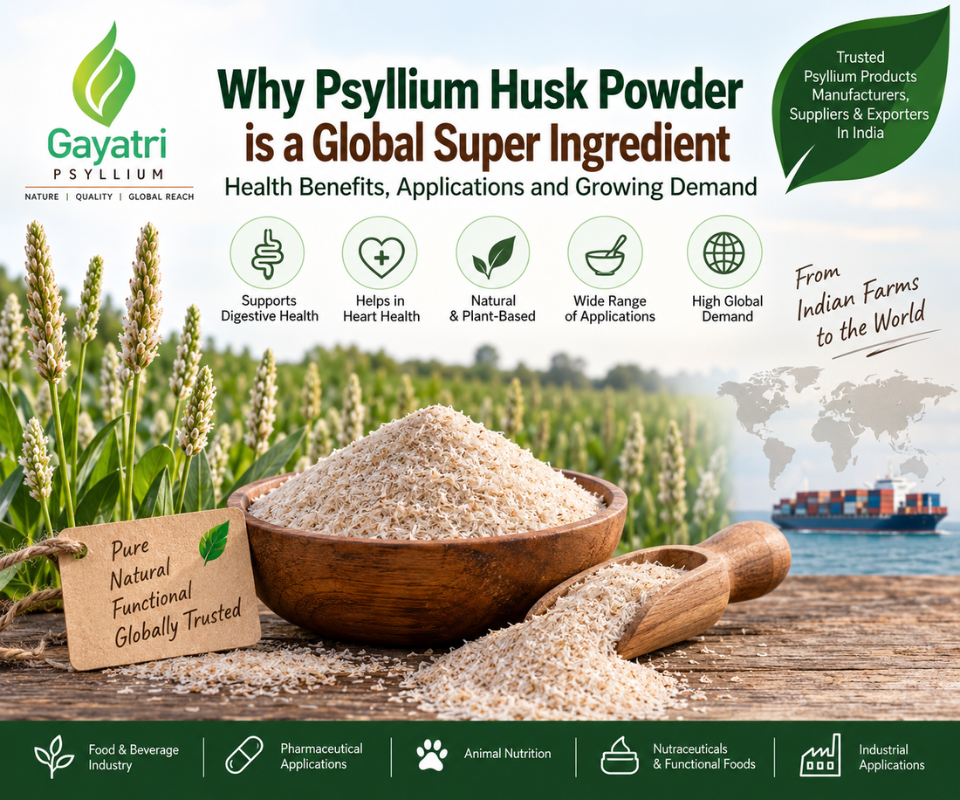
Health Benefits, Applications and Growing Demand
Psyllium husk powder is no longer a niche fiber ingredient used only in traditional digestive-health products. It is increasingly valuable to food, bakery, nutraceutical and pharmaceutical formulators because it combines a strong fiber profile with unusual functional behavior in water. A 2025 review describes psyllium husk as a highly viscous, gel-forming fiber that can work as a texturizer, stabilizer, and fat or gluten replacement in food systems.
For buyers, that changes the sourcing question. The right psyllium supplier is not simply the company offering a bag of powder at the lowest price. The more useful question is: can the supplier deliver a grade that behaves consistently in your formulation, matches your specification, and arrives with the documentation needed for your market?
Why Psyllium Husk Powder Is Becoming a Strategic Ingredient
Psyllium comes from Plantago ovata. The husk is the outer coating of the seed and is rich in soluble, highly viscous fiber. When hydrated, that fiber forms a mucilaginous gel. This simple physical property explains much of the ingredient’s commercial versatility.
- It can add dietary fiber to a finished product.
- It can bind water and influence moisture management.
- It can contribute structure and cohesion in selected formulations.
- It can support gluten-free bakery texture where gluten is absent.
- It can serve both nutrition and functionality, reducing the need to source separate ingredients for each role in some formulations.
That dual role – nutrition plus functionality – is one reason psyllium has become attractive to product developers. Instead of asking only “How much fiber does this ingredient provide?”, formulators can ask “What does this ingredient do to the final product?”
What Makes Psyllium Husk Powder Functionally Different?
High water-holding and gel-forming behavior
Psyllium behaves differently from many ordinary plant powders because hydration changes its physical state. The fiber absorbs water and develops viscosity. The result can be useful in products where water distribution, body, mouthfeel, cohesion or structure matters. The same behavior also means formulations have to be designed carefully: too little hydration can create an uneven texture, while too much can make a system overly thick or gummy.
This is particularly relevant when a food company changes the particle size or grade of psyllium. A formulation that works with one mesh or powder specification may not behave identically with another.
Fiber functionality beyond a nutrition label
The best way to think about psyllium husk powder is as a functional fiber ingredient rather than merely a supplement powder. It can be included to increase fiber content, but developers can also use it for binding, thickening, stabilization and texture control in suitable products. Research reviews have explored these roles across bakery, beverages, functional foods and other food systems.
Evidence-Based Health Benefits of Psyllium
Health claims should be handled carefully. Psyllium has meaningful clinical evidence, but the strength and wording of a claim depend on dose, product format, population and regulatory market. For a manufacturer or brand, “supported by evidence” is more useful than exaggerated language.
Digestive and bowel health
Psyllium has a long clinical history as a bulk-forming fiber. Recent review evidence continues to describe benefits for bowel function, including constipation management, because the hydrated fiber increases stool bulk and changes stool consistency.
This is one reason psyllium remains relevant to dietary supplements, digestive-health products and pharmacist-recommended fiber products.
Cholesterol and cardiovascular risk factors
Clinical research has also found reductions in LDL cholesterol with psyllium supplementation. A meta-analysis of randomized controlled trials found that a median intake of about 10.2 g/day was associated with a meaningful reduction in LDL cholesterol. The U.S. FDA also maintains a qualified health-claim reference for psyllium husk and reduced risk of type 2 diabetes, and its health-claim listings include psyllium-related soluble-fiber claims concerning coronary heart disease.
For content and product labeling, however, manufacturers should always confirm the claim language and conditions permitted in the target market rather than copying health claims from another jurisdiction.
Glycemic response and satiety: what the evidence actually supports
Psyllium’s viscosity can slow digestion and alter the rate at which nutrients interact with the digestive tract. Research reviews discuss potential roles in glycemic control and satiety, but product developers should avoid turning mechanistic findings into blanket weight-loss or diabetes-treatment promises. The better approach is to communicate psyllium as a fiber ingredient that may support specific aspects of metabolic health when used appropriately within an overall diet.
Where Psyllium Husk Powder Is Used Today
Functional foods and beverages
Psyllium can be used in fiber-fortified foods, nutrition products and selected beverages where controlled hydration and viscosity are desirable. Developers need to validate dispersion, mouthfeel, shelf stability and final viscosity at the intended serving level. Recent food-science literature highlights both the functional opportunities and the practical challenges of gumminess, hydration control and color change.
Bakery and gluten-free formulations
In gluten-free baking, psyllium can help provide structure and cohesion because gluten is absent. This makes it especially relevant to breads, flatbreads and other products where dough handling and crumb structure are difficult to reproduce.
A practical example: a gluten-free bread manufacturer may use psyllium not simply to “add fiber,” but to help create a dough that holds water and maintains a more cohesive structure during processing. The final dosage, hydration and bake profile still need formulation trials.
Nutraceuticals and dietary supplements
This remains one of the strongest commercial categories for psyllium. Powder can be sold as a standalone fiber ingredient, blended into sachets or incorporated into capsules and other formats. Ingredient buyers often prioritize predictable particle size, purity, microbiological quality and documentation because these affect manufacturing and compliance.
Pharmaceutical applications
Psyllium has a well-established use in bulk-forming laxative products and is also discussed in the clinical literature in relation to cholesterol and bowel health. Pharmaceutical buyers typically require tighter documentation, controlled specifications and validated manufacturing systems than a general food application.
Animal nutrition and other emerging uses
Psyllium is also used in selected veterinary and animal-nutrition applications. Research and industry development continue to explore other food and non-food uses because of its water-holding and gel-forming behavior.
Why Demand Is Growing in Global Ingredient Markets
Three market forces are reinforcing each other. First, consumers and brands continue to prioritize dietary fiber and digestive wellness. Second, product developers are looking for multifunctional, recognizable ingredients rather than long lists of synthetic processing aids. Third, gluten-free and specialty formulations create technical problems that a highly hydrophilic fiber can help address.
Trade data also shows that psyllium remains an active international ingredient category. In 2026, Volza’s shipment database reported thousands of Indian psyllium husk and psyllium powder export shipments and hundreds of overseas buyers and suppliers tracked in its dataset. These figures are shipment-intelligence data rather than official customs statistics, but they are useful as a directional signal of active cross-border sourcing.
India is particularly important in this supply chain. Industry and market research sources describe India as a leading global source of psyllium, with western Indian cultivation regions playing a major role. For international buyers, this creates an established sourcing ecosystem – but also makes supplier differentiation more important.
What Buyers Should Check Before Choosing a Psyllium Supplier
Buying psyllium by product name alone is risky. A better procurement process starts with the finished application and works backward to a technical specification.
Purity, mesh size and specification fit
Ask for a clear specification sheet covering purity, particle size or mesh, appearance, moisture and any other parameters that matter to your formulation. Gayatri Psyllium’s current product information describes psyllium husk powder grades from 80% to 99% purity and mesh sizes from 40 to 100, illustrating why a buyer should specify the intended grade instead of requesting “psyllium powder” generically.
Microbiology, testing and documentation
For food, nutraceutical or pharmaceutical applications, request recent batch-level documentation such as a Certificate of Analysis (COA), microbiological results and other contaminant or residue tests relevant to your specification and destination market. A supplier should also explain how traceability is maintained from incoming seed through processing and packing.
Batch consistency, packaging and logistics
Consistency is a commercial advantage. Packaging should protect the product from moisture and contamination, while logistics should match your buying pattern – trial quantities, regular containerized supply, private label or bulk industrial shipments.
Gayatri describes a fully automatic processing facility for psyllium husk and pulverized husk, with pneumatic conveying and separation intended to reduce human touch. Its site also describes an installed capacity of 1,500 metric tonnes per annum for psyllium husk. Buyers should still validate current capacity, lead times and export documentation during qualification.
Why Indian Psyllium Matters to Global Buyers
India has an established psyllium cultivation and processing base, and Gujarat is a major center for the industry. Gayatri Psyllium Industries says it was incorporated in 2009 and exports psyllium products to more than 35 countries. That export experience is relevant to buyers who need more than a commodity purchase: they need documentation, communication, packaging options, and dependable shipment execution.
For procurement teams searching for a Psyllium Husk Powder Manufacturer in India, Psyllium Husk Powder Exporter, Psyllium Seeds Manufacturer India, or Isabgol Exporter in India, the useful comparison is not just price. Compare product specification, technical responsiveness, batch consistency, testing, packaging, and the supplier’s ability to support your destination market.
Practical Example: Choosing the Right Psyllium Grade
Imagine a supplement company launching a flavored fiber sachet for the European market. Its first sample performs well in the lab, but the second supplier’s powder produces noticeably different viscosity. The procurement team could respond by negotiating price – but the better solution is to investigate the specification.
- Confirm the target purity and mesh size.
- Compare hydration behavior under the same process conditions.
- Review batch COAs and microbiological results.
- Confirm packaging and storage conditions.
- Run a pilot batch before approving a long-term supply program.
- Document the approved specification so future purchasing stays consistent.
This is the difference between buying a commodity and sourcing a functional ingredient: the finished product, not the supplier’s catalog name, determines what “the right psyllium” means.
How Gayatri Can Support Different Psyllium Requirements
Gayatri’s product portfolio includes Psyllium Seeds, Psyllium Husk, Psyllium Husk Powder, Organic Psyllium Husk, Organic Psyllium Husk Powder, Psyllium Kha-Kha Powder and EAGLE Sat-Isabgol. This allows buyers to evaluate multiple stages and formats of the psyllium value chain through one supplier relationship.
For powder buyers, Gayatri provides product information covering grade, mesh, applications and bulk packaging. For buyers who need a tailored specification, the most efficient route is to share the intended application, target market, required mesh or purity, estimated annual volume and packaging preference when requesting a quotation.
FAQs About Psyllium Husk Powder
What is psyllium husk powder?
Psyllium husk powder is the milled form of the husk surrounding Plantago ovata seeds. It is valued for its dietary-fiber content and its ability to absorb water and form a viscous gel.
What makes psyllium husk powder different from psyllium seeds?
Seeds are the whole reproductive part of Plantago ovata. The husk is the outer seed coating, and the powder is the milled form of that husk. Their applications and handling properties are therefore different.
Which industries use psyllium husk powder?
Common applications include food and bakery, nutraceuticals and dietary supplements, pharmaceutical products, selected beverages, and some animal-nutrition uses.
What should I ask a psyllium supplier for before placing a bulk order?
Request the product specification, target purity and mesh, COA, microbiological and relevant contaminant testing, packaging details, traceability information, lead time, and export documents required for your destination market.
Does psyllium help with cholesterol?
Clinical evidence supports a cholesterol-lowering effect, particularly for LDL cholesterol, when psyllium is consumed at studied doses. Product labeling and claims should follow the regulations of the target market.
Is psyllium suitable for gluten-free formulations?
Yes. Psyllium can be used as a functional fiber in gluten-free bakery and other formulations because its hydration and gel-forming properties can contribute structure and cohesion.
How do I choose the right psyllium mesh size?
Start with the application and pilot trials. Finer and coarser powders can behave differently in dispersion, hydration and texture. Your formulation team should approve the mesh based on actual process performance rather than buying on mesh number alone.
Can Gayatri supply psyllium for international markets?
Gayatri states that it exports psyllium products to more than 35 countries and provides bulk and product-specific supply options. Buyers should share destination, specification, packaging and volume requirements for a current quotation.
Conclusion
Psyllium husk powder earns its “super ingredient” reputation for a practical reason: it sits at the intersection of nutrition and formulation performance. Scientific literature supports its role as a viscous dietary fiber with applications extending well beyond traditional laxative products, including food structure, gluten-free formulation and functional-food development.
At the same time, demand is being shaped by global interest in fiber, digestive wellness, clean-label formulation and multifunctional ingredients. For buyers, that makes supplier qualification more important. The best psyllium partnership is built on specification control, testing, consistency, documentation and reliable supply – not on marketing claims alone.
Talk to Gayatri Psyllium
Looking for a reliable Psyllium Husk Powder Manufacturer in India or a long-term Psyllium Products Supplier for international markets? Gayatri Psyllium Industries supplies psyllium seeds, husk and husk powder for food, nutraceutical, pharmaceutical and related applications.
Share your product application, required purity/mesh, estimated quantity, packaging preference and destination country to receive a tailored quotation.
Website: gayatripsyllium.com
Inquiry: Request a Product Quote