How to Evaluate Psyllium Husk & Powder from India: A Buyer’s Specification Checklist
Buying psyllium from India can look simple until the first production batch behaves differently from the sample. A specification that says only “99% psyllium husk” does not tell a formulator everything needed to judge processing performance, consistency or regulatory fit. For importers and manufacturers, the better approach is to define the product, the critical quality attributes and the documents required before the purchase order is issued.
This is especially important because psyllium is sold in different forms and grades. Gayatri Psyllium Industries currently lists Psyllium Seeds, Psyllium Husk and Psyllium Husk Powder as separate products, with powder available in different purity and mesh ranges. Its site also describes a dedicated processing plant and in-house testing capability. Those are useful starting points, but the buyer should still qualify each product against the specification for the intended application.
Start with the exact product form
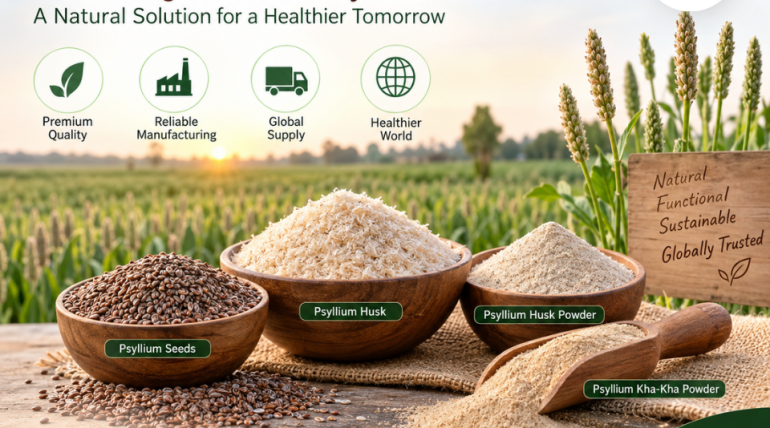
Before comparing suppliers, write down what you actually need: whole Psyllium Seeds, whole Psyllium Husk, Psyllium Husk Powder, an organic grade, or another product such as Psyllium Kha-Kha Powder. Whole seeds are the raw material used to produce husk; powder is milled husk; and each form has a different role in a manufacturing process. Gayatri’s product pages describe these distinctions and give indicative product-specific specifications.
A practical purchasing rule is simple: never ask a supplier for “psyllium” when your production line requires a defined form. Put the exact form in the RFQ title and repeat it on the technical specification and purchase order.
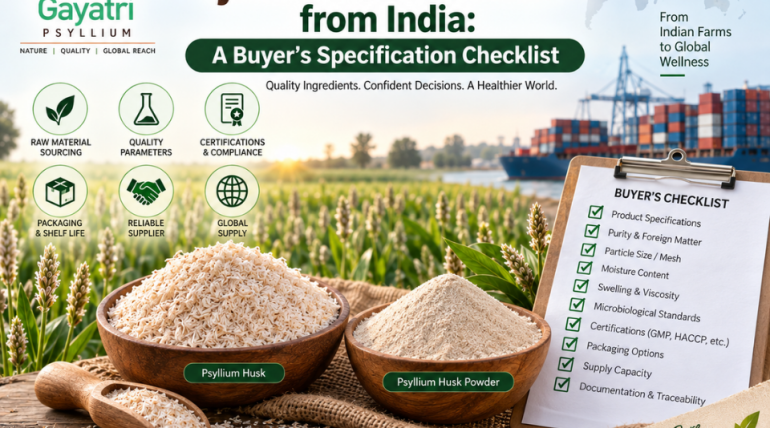
The 10 checks every buyer should define
1. Botanical identity and origin
Use Plantago ovata / Ispaghula terminology and state the origin you require. For many buyers, India is the commercial sourcing origin, while the documentation should still show the lot and supplier identity.
2. Purity / grade
Do not treat one purity figure as a universal quality score. Decide whether your application needs food, nutraceutical, pharmaceutical or industrial material and ask the supplier to define how purity is measured.
3. Swelling performance
Swelling is a major functional property because psyllium forms a viscous gel when hydrated. For formulation work, request the test method and acceptance range rather than a marketing phrase such as “high swelling.” Gayatri publishes grade-specific swelling values on its organic powder page, which illustrates why buyers should compare the number and the method together.
4. Mesh and particle-size distribution
Powder mesh changes handling, dispersion, mouthfeel and processing behavior. Instead of asking for “fine powder,” name the target mesh or particle-size window and define the tolerance.
5. Moisture and ash
Moisture affects stability and handling; ash can help indicate inorganic content. These values belong on the agreed specification and the COA.
6. Microbiological quality
For food, nutraceutical and pharmaceutical applications, agree on the microbiological limits and the test methods relevant to the finished material. Ask how results are generated and whether each lot is tested.
7. Pesticide residues and heavy metals
Destination-market rules can be stricter than the supplier’s standard specification. Request current test results or a compliance statement that matches your target market and product category.
8. Sterilization or microbial-reduction process
Where microbial reduction is necessary, clarify the process used, the validation expectations and how it affects the finished ingredient. Do not assume that a generic “export grade” label answers the question.
9. Packaging and storage
Specify bag or drum format, liner material, net weight, palletization if needed, moisture protection and label requirements. Gayatri’s MSDS also advises protecting psyllium from humidity and storing it in cool, dry, closed conditions.
10. COA, traceability and documentation
The Certificate of Analysis should match the lot actually shipped. A useful buyer file can include the COA, product specification, packing list, origin information, batch or lot number, allergen statement where relevant, and destination-market documentation.
Build a supplier comparison sheet
A good supplier comparison sheet makes hidden differences visible. Put suppliers in columns and the technical attributes in rows. Compare the same grade, the same mesh, the same test method and the same delivery term. Otherwise a lower quote can simply reflect a different product.
- Product form and purity
- Swelling specification + test method
- Mesh / particle size
- Moisture and ash
- Microbiological limits
- Heavy metals / pesticide-residue evidence
- Packaging and net weight
- MOQ and lead time
- Incoterm / destination logistics
- COA and traceability
- Sample-to-bulk consistency plan
Then calculate the landed cost. Include freight, duty or local import costs, inspection costs, warehousing and any relabelling or repacking requirement. For a manufacturer, a slightly higher ingredient price can still be lower total cost if the material produces fewer rejects, less rework and more predictable performance.
Practical RFQ example
Food formulation example
A gluten-free bakery brand needs Psyllium Husk Powder for a bread and wrap line. Its RFQ could specify: Plantago ovata husk powder; target mesh; moisture maximum; ash maximum; agreed swelling range; microbiological limits; allergen status; packaging; shelf life; COA with every lot; and sample approval before the commercial order. The key is that the supplier is being asked to quote a defined functional ingredient, not a generic “psyllium powder.”
Supplement example
A fibre-supplement company may need a different powder profile, tighter documentation, and a stronger focus on microbiological controls and destination-market compliance. In that case, the RFQ should identify the intended finished dosage form, the applicable regulatory category and the required test package. FDA, for example, recognizes psyllium husk within its dietary-fiber framework and lists a qualified health-claim context for psyllium husk, but a buyer must still follow the labeling and regulatory rules that apply to its specific product and market.
Questions to ask before approving a supplier
- Can you send the latest product specification and a recent lot COA?
- Can you match the approved sample in the commercial batch?
- Which parameters are tested on every lot, and which are periodic?
- Can you supply a buyer-defined mesh, purity or packaging configuration?
- What is the normal production lead time after specification approval?
- How is the lot identified from production through shipment?
- Which export documents will be included with the shipment?
- Can you support a repeat-order program for the same specification?
Conclusion
The best Psyllium Products Suppliers India are not simply the ones offering a low quote. The stronger supplier is the one that can translate your end use into a clear product specification, provide lot-level evidence, maintain consistent manufacturing and support your export or domestic documentation workflow.
For importers looking for Psyllium Husk Manufacturers In India or Psyllium Husk Powder Exporters, the practical next step is to send a specification-led RFQ. That gives both sides a clearer target and makes future repeat orders easier to manage.
Talk to Gayatri Psyllium Industries about your grade, mesh, purity, packaging and export requirement. Request product details, a specification sheet or a quotation at gayatripsyllium.com.
Frequently Asked Questions (FAQs)
What is the most important parameter when buying psyllium?
There is no single parameter for every application. Product form, purity, swelling performance, particle size, microbiological quality and regulatory fit should be evaluated together.
Is higher purity always better?
Not automatically. A higher-purity material can be unnecessary for some uses, while a regulated application may need a tighter specification. Buy to application, not to the highest number.
Why does mesh matter in Psyllium Husk Powder?
Mesh is a practical proxy for particle size. It can affect dispersion, texture, flow, processing and the feel of the final product, so the target should be agreed in advance.
Should the COA be checked for every shipment?
For commercial ingredients, lot-specific verification is a strong procurement practice. It allows the buyer to compare the shipped batch with the agreed specification and the approved sample.
How can an importer compare Psyllium Husk Suppliers India?
Use a scorecard covering product identity, specifications, testing, documentation, packaging, logistics, responsiveness and sample-to-bulk consistency. Price should be one line in the scorecard, not the whole decision.