Psyllium Husk vs Psyllium Husk Powder: Which Is Better for Supplements, Foods & Gut Health?
As demand for natural fiber ingredients continues to grow across the USA, Europe, Middle East, and Asia-Pacific markets, both psyllium husk and psyllium husk powder have become essential ingredients in dietary supplements, functional foods, and digestive health products. However, many consumers, food formulators, and supplement brands still ask: Is psyllium powder better than whole husk?
The answer depends on the intended application. Understanding the difference between these two forms can help manufacturers, importers, and health-conscious consumers make the right choice.
What Is Psyllium Husk?
Psyllium husk is the outer coating of the seeds of Plantago ovata, a plant primarily cultivated in India, which supplies more than 80% of the world’s psyllium exports. The husk is naturally rich in soluble fiber and is commonly used to support digestive health, bowel regularity, and overall wellness.
When mixed with water, Psyllium Husk expands and forms a gel-like consistency that helps promote healthy digestion. Due to its coarse, flaky texture, whole husk is often consumed directly with water or added to fiber supplements.
What Is Psyllium Husk Powder?
Psyllium husk powder is produced by grinding whole psyllium husk into a finer particle size. While it contains the same beneficial fiber as whole husk, the powder form offers improved dispersibility, faster hydration, and easier incorporation into food and supplement formulations.
Because of its fine texture, Psyllium Husk Powder is widely used in capsules, sachets, drink mixes, bakery products, and functional foods.
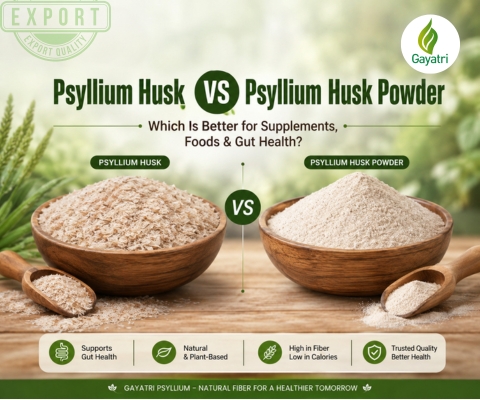
Psyllium Husk vs Psyllium Husk Powder: Key Differences
| Feature | Psyllium Husk | Psyllium Husk Powder |
|---|---|---|
| Texture | Coarse flakes | Fine powder |
| Water Absorption | Moderate | Faster hydration |
| Mixing Ability | Basic | Excellent |
| Supplement Manufacturing | Good | Preferred |
| Food Applications | Limited | Highly versatile |
| Gluten-Free Baking | Moderate | Excellent |
| Consumer Convenience | Good | Better |
In the psyllium husk vs psyllium powder comparison, the primary difference lies in particle size and functionality. Both deliver similar fiber content, but powdered psyllium offers greater versatility across industries.
Psyllium Husk Powder Benefits for Gut Health
One of the biggest reasons for the global popularity of psyllium husk powder is its digestive support properties. The soluble fiber absorbs water and forms a gel that helps support normal bowel function.
Major psyllium husk powder benefits include:
- Supports digestive regularity
- Helps maintain a healthy gut microbiome
- Promotes healthy bowel movements
- Assists with occasional constipation relief
- Supports heart health through dietary fiber intake
- Helps improve feelings of fullness
For this reason, psyllium powder for gut health remains one of the most sought-after ingredients in fiber supplements worldwide.
Psyllium Powder for Constipation Relief
Among the most common psyllium husk powder uses is digestive support. Many healthcare professionals recommend psyllium powder for constipation because it absorbs water in the digestive tract, helping soften stools and promote easier elimination.
Its fine texture also allows for quicker mixing and consumption compared to whole husk products.
Psyllium Husk Powder for Gluten-Free Baking
Absolutely. Psyllium powder for baking is widely used in gluten-free and high-fiber recipes because it acts as a natural binding and thickening agent.
Food manufacturers use psyllium powder in:
- Gluten-free bread
- Pizza bases
- Tortillas and wraps
- High-fiber snacks
- Plant-based food products
Its ability to improve texture and moisture retention makes it a preferred ingredient in modern food formulations.
How Is Psyllium Husk Powder Manufactured?
The production process begins with cleaning and separating the husk from Plantago ovata seeds. The husk is then processed and finely milled into powder under controlled conditions. Reputable psyllium powder suppliers and manufacturers conduct rigorous quality testing for purity, fiber content, microbiological safety, and export compliance.
India remains the leading global hub for psyllium production, supplying premium-quality ingredients to supplement and food brands worldwide.
Which Is Better: Psyllium Husk or Psyllium Husk Powder?
For direct fiber consumption, both forms provide similar nutritional benefits. However, for supplement manufacturing, food processing, and functional product development, psyllium husk powder is generally considered the superior option due to its finer texture, better mixing characteristics, and broader application range.
Whether you’re a consumer seeking digestive support, a food manufacturer developing gluten-free products, or an importer sourcing premium fiber ingredients, psyllium powder offers greater flexibility and functionality.
Frequently Asked Questions (FAQs)
What is the difference between psyllium husk and psyllium husk powder?
Psyllium husk powder is a finely ground version of psyllium husk that offers faster hydration and better mixing. Gayatri Psyllium supplies both forms for food, supplement, and industrial applications.
Why is Gayatri Psyllium Industries a trusted psyllium manufacturer in India?
Gayatri Psyllium Industries manufactures premium-quality psyllium products with stringent quality controls, serving food, nutraceutical, pharmaceutical, and dietary supplement industries worldwide.
What products does Gayatri Psyllium Industries offer?
Gayatri Psyllium Industries supplies Psyllium Husk, Psyllium Husk Powder, Psyllium Seed, Psyllium Industrial Powder, and customized psyllium solutions for global manufacturers.
Which form is better for gut health: psyllium husk or psyllium powder?
Both support digestive regularity and gut health, as they contain the same beneficial soluble fiber. Gayatri Psyllium supplies premium psyllium ingredients for digestive wellness products.
What industries use Gayatri Psyllium products?
Gayatri Psyllium products are used across dietary supplements, nutraceuticals, pharmaceuticals, functional foods, bakery products, wellness brands, and digestive health formulations.