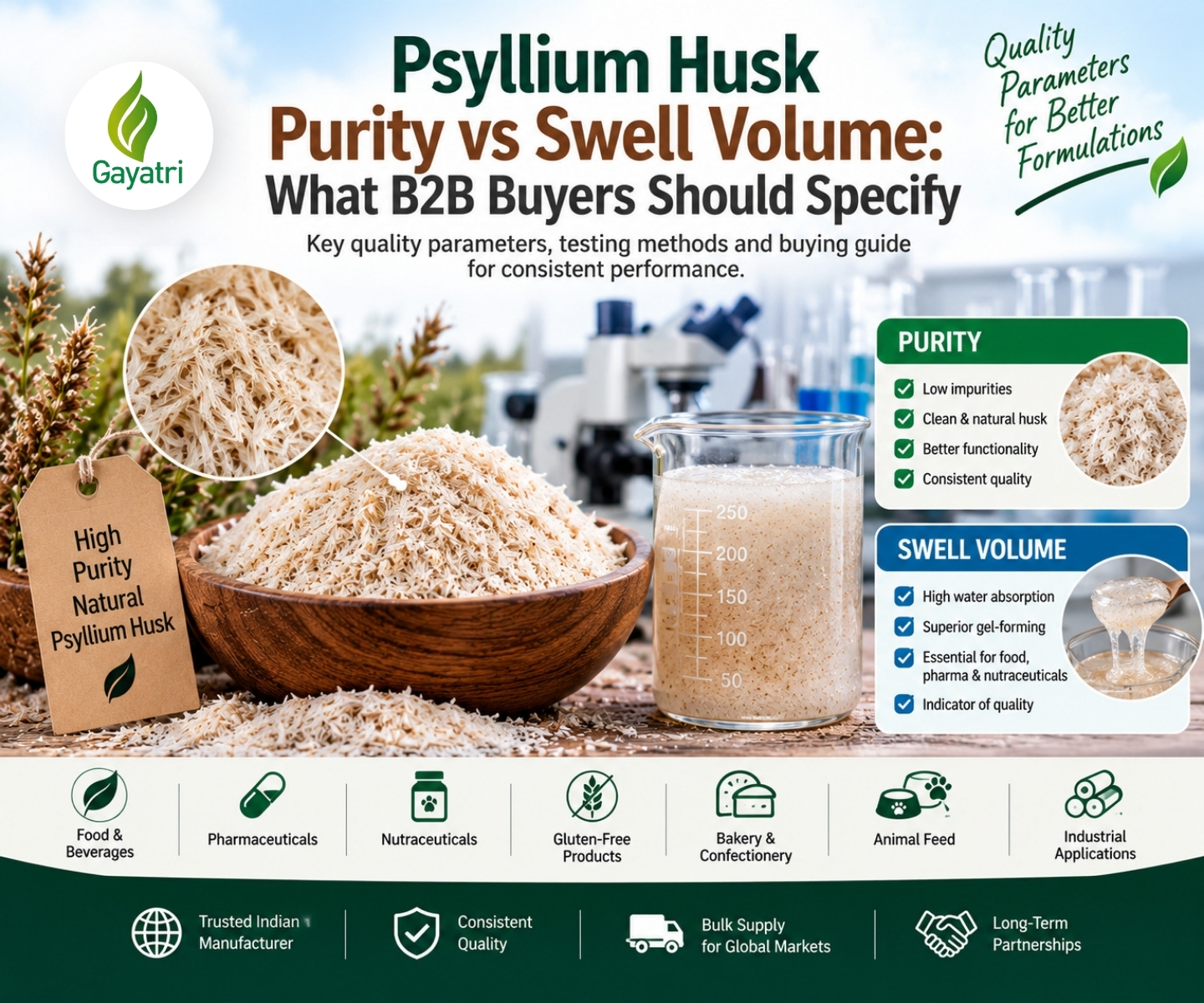
Psyllium buying becomes much easier once the specification is written around the finished application rather than around a supplier’s product name. A food company making a fibre blend, a bakery using psyllium for structure, and a pharmaceutical manufacturer may all ask for “psyllium husk”, but the critical attributes, test methods and acceptable ranges can be different.
Purity Is Important – But It Is Not the Whole Product
Psyllium husk is the seed coat obtained from Plantago ovata. In commercial trade, buyers commonly see grades expressed as percentages, but the practical meaning of that number is tied to the amount of desired husk relative to unwanted material and the test method used. Gayatri currently publishes commercial husk grades from 80% to 99% and shows different swell-volume targets by grade.
A simple way to interpret the number
Think of purity as a cleanliness/specification indicator, not as a complete performance score. Two products carrying similar purity labels can still behave differently in production if their swell volume, particle-size distribution, moisture or processing history differs.
Why Swell Volume Matters to Formulators
Swell volume is a functional hydration measurement. It indicates how much the material expands when hydrated under a defined test. FSSAI’s Indian reference standard for psyllium husk includes a minimum swell-volume requirement, while suppliers may offer commercial grades above that baseline. The correct comparison is always product form + test method + agreed specification.
Example: a bakery and a capsule manufacturer
A gluten-free bakery may care most about water binding, dough handling and texture at a defined mesh. A supplement manufacturer may require tighter controls around purity, microbiology, heavy metals and lot traceability. Both can use psyllium, but the buying specification should reflect the finished product.
Other Parameters to Put on the Specification Sheet
- Moisture: helps with storage stability and batch consistency.
- Total ash and acid-insoluble ash: useful indicators in the quality-control program.
- Extraneous matter: important for purity and finished-product quality.
- Mesh / particle size: critical for powder flow, dispersion and formulation behaviour.
- Microbiology: define the organisms and limits relevant to the product and destination market.
- Heavy metals and pesticide residues: align the testing program with the destination-market and application requirements.
- Packaging: specify bag type, lining, net weight and palletization where relevant.
How to Write a Buyer-Ready Psyllium RFQ
Instead of sending a request that says “Please quote 1 MT of 99% psyllium,” build the enquiry around a short technical block. State the product form, intended use, target grade, mesh, functional target, microbiological limits, packing, annual or monthly requirement, destination and document requirements.
A practical RFQ example
Product: Psyllium Husk | Intended use: fibre blend | Target grade: 98-99% | Functional requirement: agreed swell-volume method and target | Microbiology: buyer specification | Documents: lot COA, specification sheet, origin/export documents | Packing: 25 kg food-contact bags | Sample: 1-2 kg from the same commercial grade
How to Compare Samples Fairly
Approve samples using the same test conditions. Record supplier, lot number, manufacture date, test method and results. For a meaningful comparison, keep the sample preparation and hydration procedure consistent; a difference in test method can look like a difference in product performance.
From Sample Approval to Commercial Lot
The most useful supplier relationship is one where the approved specification becomes the control document for future lots. Before shipment, buyers should review the commercial COA against the agreed parameters and confirm lot identity. Current Indian buyer guides increasingly emphasize lot-specific COAs, test methods, and named specifications rather than price-only purchasing.
Why Indian Origin Matters for Global Buyers
India is a major center for psyllium production and processing, with North Gujarat-especially the Unjha belt-playing a central role in the trade. Gayatri states that its facility in Gujarat manufactures psyllium seeds, husk and powder and exports to more than 35 countries.
A Five-Question Supplier Check
- Can you provide a lot-specific COA for the exact grade being quoted?
- Can you explain the test method for swell volume and other functional parameters?
- Can you supply the same specification consistently across repeat lots?
- Can you support destination-market documentation and packaging requirements?
- Can you provide technical contact support when the buyer is validating a formulation or changing mesh/grade?
Frequently Asked Questions
What is more important, psyllium purity or swell volume?
Neither should be viewed alone. Purity helps define the material specification, while swell volume is a functional measure. Buyers should set both against the intended application and agreed test methods.
Is 99% psyllium husk automatically pharma grade?
No. A 99% label by itself is not enough to establish pharmaceutical suitability. Pharmaceutical programs should be qualified against the applicable monograph, testing, documentation and regulatory requirements.
Should psyllium powder have a mesh specification?
Yes. Powder particle size can affect dispersion, hydration and processing behaviour, so mesh or particle-size distribution should be part of the purchase specification when relevant.
What should a COA include?
At minimum, the agreed product identity/grade, lot number, test parameters, methods, results and limits. The exact panel should be tailored to application and destination requirements.
Conclusion
A reliable psyllium purchase is a specification exercise, not just a price comparison. When purity, swell volume, mesh, safety parameters, documentation and lot traceability are agreed before the purchase order, buyers reduce formulation surprises and make supplier performance easier to measure.
CTA for Gayatri Psyllium
Need a buyer-specific psyllium specification? Share your application, target grade, mesh, monthly volume and destination with Gayatri Psyllium Industries. Our team can help match the requirement to an appropriate Psyllium Husk or Psyllium Husk Powder specification and export documentation set.