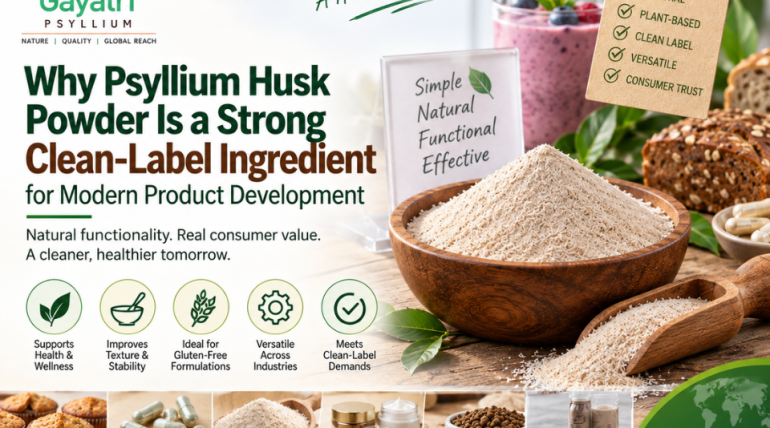
Why Psyllium Husk Powder Is a Strong Clean-Label Ingredient for Modern Product Development
Psyllium has moved beyond the traditional “fibre supplement” conversation. Product developers now look at Psyllium Husk Powder as a multifunctional plant-based ingredient that can contribute dietary fibre while also changing water management, dough structure and texture. Recent food research continues to discuss psyllium in clean-label and gluten-free bakery systems, where it can help provide structure that is otherwise difficult to obtain without conventional hydrocolloids.
For brands, the opportunity is not to add psyllium to everything. It is to identify product formats where its functional behavior solves a real formulation problem.
Why formulation teams are revisiting psyllium
Fibre plus function
Psyllium is an unusually practical ingredient because its value is not limited to a nutrition panel. Hydrated psyllium can swell and form a gel-like system, which can influence viscosity, water distribution, binding and product structure. The exact effect depends on the grade, particle size, dosage, mixing sequence and the rest of the formula.
That matters to product developers working on high-fibre foods, gluten-free bakery, fibre blends, supplement powders and other formats where water management is central to the process.
A plant-based ingredient with practical formulation roles
Clean-label positioning is not a technical specification by itself. In practice, a formulator may be trying to reduce a long additive declaration, replace or reduce a conventional hydrocolloid, improve handling, increase fibre, or create a more familiar ingredient story. Research on gluten-free breads has specifically examined psyllium as an option for replacing some of the texturing function normally supplied by additives.
Gluten-free bakery
Gluten-free doughs lack the gluten network that normally helps hold gas and structure. Psyllium can contribute a water-binding and gel-forming function that supports dough handling and crumb structure. The right dose is application-specific: too little may not give the desired structure; too much can make a product heavy, gummy or difficult to process.
Fibre-rich foods and mixes
In fibre blends, instant mixes and nutrition-oriented dry products, psyllium can increase fibre contribution while changing hydration and mouthfeel. This makes it important to run a controlled water-activity, texture and dispersion assessment instead of selecting the ingredient by fibre percentage alone.
Beverages and supplement formats
Psyllium can be used in powders and beverage-style formats, but the formulator must plan for rapid hydration. A product that sits on a shelf for months may behave very differently after reconstitution. Dispersion time, viscosity after standing, serving size, flavour release and the user instructions should all be tested.
Nutraceutical products
In regulated categories, the formulation conversation must be paired with market-specific labeling and health-claim rules. FDA recognizes psyllium husk within the dietary-fiber definition and has a qualified health-claim context for psyllium and reduced risk of type 2 diabetes; a finished-product claim still needs to meet the applicable regulatory conditions.
Formulation decisions that matter
Powder mesh
Mesh influences particle size, dispersion and mouthfeel. A finer powder may behave differently in mixing and hydration than a coarser grade. Choose the mesh around the process, not only around the label description.
Purity and swelling
Two powders that are both called “psyllium husk powder” can perform differently. When the formulation is sensitive to viscosity or gel strength, request swelling data and the test method. Gayatri currently lists multiple purity and mesh configurations for its Psyllium Husk Powder range.
Hydration and mixing sequence
Psyllium absorbs water quickly. A bench trial should record the water temperature, order of addition, mixing energy and resting time. Changing any of those can change the outcome.
Taste, texture and dosage trade-offs
“More fibre” does not automatically mean “better product.” Sensory acceptance, chewiness, viscosity, colour, package stability and consumer instructions all matter. Formulate to the final eating experience.
A simple development workflow
Bench test
Start with three psyllium levels around a target range and keep everything else constant. Measure water uptake, mixing behavior, viscosity or dough handling, product weight loss and texture after a defined rest time. Photographing the batter or dough at fixed time points can also make comparison easier.
Pilot test
Once the best bench sample is clear, repeat it on pilot equipment. Equipment geometry can change shear, hydration and mixing efficiency. This is where you discover whether a formulation that works in a beaker or small mixer still works on the production line.
Specification lock
Record the accepted grade, purity, mesh, swelling range, moisture target, packaging and COA requirements. This turns a successful R&D sample into a repeatable commercial ingredient specification.
What buyers should request from a supplier
- A representative sample from the proposed commercial grade
- Current specification sheet and lot COA
- Target mesh or particle-size information
- Swelling specification and test method where functional performance matters
- Microbiological and contaminant documentation appropriate to the market
- Available packing formats and shelf-life information
- Ability to supply the same specification on repeat orders
- A clear contact path for technical questions
Gayatri states that its processing plant is designed for psyllium husk and powdered husk, and its site describes pneumatic conveying, controlled processing and in-house testing. Buyers should still validate the exact controls and certificate package required for their own application and market.
Practical example: a gluten-free wrap
Imagine a manufacturer reformulating a gluten-free wrap to improve flexibility while keeping the ingredient statement short. The developer starts with the current flour blend, then runs three pilot levels of Psyllium Husk Powder while controlling water and mixing time. The team records dough handling, sheetability, tearing, cooking loss and next-day flexibility. The winning version becomes the target specification for the supplier sample and the future purchase order. This approach is more reliable than selecting a “premium” powder first and trying to force the formulation around it.
Conclusion
Psyllium Husk Powder is valuable when its functional behavior is matched to the product problem. For R&D teams, the smart path is to control the variables, test the actual grade, lock a measurable specification and then build a repeatable supply relationship.
For brands searching for Psyllium Husk Powder Manufacturers In India, Psyllium Products Manufacturers In India or Psyllium Products Exporters, a technical conversation is often more productive than a generic price request. Share the formula objective, process and target market and ask for a grade that can be evaluated against those requirements.
Talk to Gayatri Psyllium Industries about your grade, mesh, purity, packaging and export requirement. Request product details, a specification sheet or a quotation at gayatripsyllium.com.
Frequently Asked Questions (FAQs)
Is Psyllium Husk Powder the same as a generic fibre powder?
No. Psyllium is a specific plant-derived ingredient with characteristic hydration and gel-forming behavior. A product developer should evaluate both its nutrition contribution and its processing function.
Can psyllium improve gluten-free bread?
It can support structure and water management in some gluten-free bakery formulations, but results depend on the flour system, hydration, dosage and process. It should be validated through bench and pilot trials rather than assumed.
Which mesh should I choose?
Choose the mesh that gives the required dispersion, texture and process behavior. There is no single best mesh for all applications.
Should I buy organic or conventional psyllium?
The decision should follow the finished-product positioning, certification needs and destination-market requirements. Do not pay for an attribute you cannot use or substantiate on the label.
How can a formulator work with Psyllium Husk Powder Manufacturers In India?
Send the supplier a short technical brief covering end use, target mesh, purity, required tests, packaging, expected annual volume and destination market. That gives the manufacturer a better basis for recommending a grade.