Gayatri Psyllium Industries manufactures and exports a complete range of premium psyllium products for the food, pharmaceutical, nutraceutical, animal feed, and industrial sectors. Manufactured in our advanced facility at Unjha, Gujarat, our products meet international quality standards and are supplied to customers in more than 35 countries. With strict quality control, global certifications, and private labeling capabilities, we deliver consistent quality for worldwide markets. ">
Buyer-Specification-Checklist

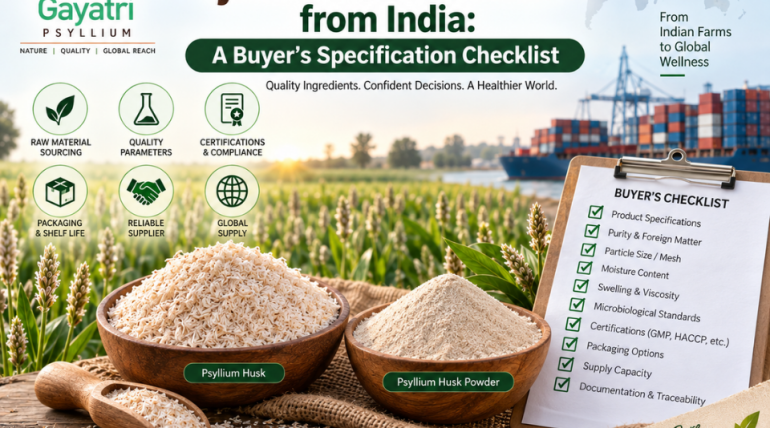
How to Evaluate Psyllium Husk & Powder from India: A Buyer’s Specification Checklist

Buying psyllium from India can look simple until the first production batch behaves differently from the sample. A specification that says only “99% psyllium husk” does not tell a formulator everything needed to judge processing performance, consistency or regulatory fit. For importers and manufacturers, the better approach is to define the product, the critical quality attributes and the documents required before the purchase order is issued.

This is especially important because psyllium is sold in different forms and grades. Gayatri Psyllium Industries currently lists Psyllium Seeds, Psyllium Husk and Psyllium Husk Powder as separate products, with powder available in different purity and mesh ranges. Its site also describes a dedicated processing plant and in-house testing capability. Those are useful starting points, but the buyer should still qualify each product against the specification for the intended application.

Start with the exact product form

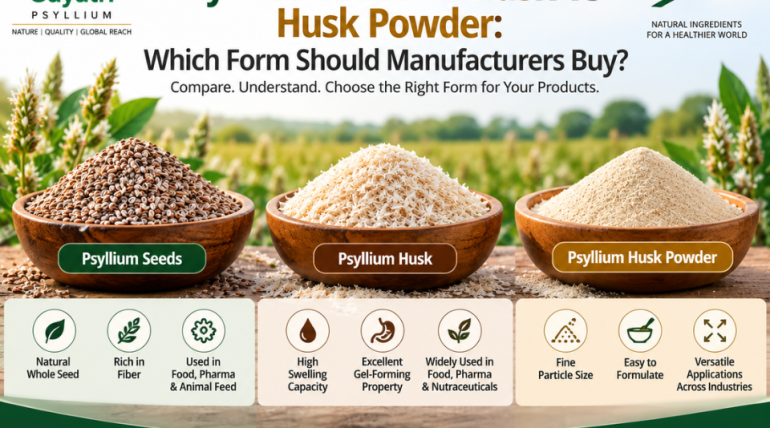
Before comparing suppliers, write down what you actually need: whole Psyllium Seeds, whole Psyllium Husk, Psyllium Husk Powder, an organic grade, or another product such as Psyllium Kha-Kha Powder. Whole seeds are the raw material used to produce husk; powder is milled husk; and each form has a different role in a manufacturing process. Gayatri’s product pages describe these distinctions and give indicative product-specific specifications.

A practical purchasing rule is simple: never ask a supplier for “psyllium” when your production line requires a defined form. Put the exact form in the RFQ title and repeat it on the technical specification and purchase order.

The 10 checks every buyer should define

1. Botanical identity and origin

Use Plantago ovata / Ispaghula terminology and state the origin you require. For many buyers, India is the commercial sourcing origin, while the documentation should still show the lot and supplier identity.

2. Purity / grade

Do not treat one purity figure as a universal quality score. Decide whether your application needs food, nutraceutical, pharmaceutical or industrial material and ask the supplier to define how purity is measured.

3. Swelling performance

Swelling is a major functional property because psyllium forms a viscous gel when hydrated. For formulation work, request the test method and acceptance range rather than a marketing phrase such as “high swelling.” Gayatri publishes grade-specific swelling values on its organic powder page, which illustrates why buyers should compare the number and the method together.

4. Mesh and particle-size distribution

Powder mesh changes handling, dispersion, mouthfeel and processing behavior. Instead of asking for “fine powder,” name the target mesh or particle-size window and define the tolerance.

5. Moisture and ash

Moisture affects stability and handling; ash can help indicate inorganic content. These values belong on the agreed specification and the COA.

6. Microbiological quality

For food, nutraceutical and pharmaceutical applications, agree on the microbiological limits and the test methods relevant to the finished material. Ask how results are generated and whether each lot is tested.

7. Pesticide residues and heavy metals

Destination-market rules can be stricter than the supplier’s standard specification. Request current test results or a compliance statement that matches your target market and product category.

8. Sterilization or microbial-reduction process

Where microbial reduction is necessary, clarify the process used, the validation expectations and how it affects the finished ingredient. Do not assume that a generic “export grade” label answers the question.

9. Packaging and storage

Specify bag or drum format, liner material, net weight, palletization if needed, moisture protection and label requirements. Gayatri’s MSDS also advises protecting psyllium from humidity and storing it in cool, dry, closed conditions.

10. COA, traceability and documentation

The Certificate of Analysis should match the lot actually shipped. A useful buyer file can include the COA, product specification, packing list, origin information, batch or lot number, allergen statement where relevant, and destination-market documentation.

Build a supplier comparison sheet

A good supplier comparison sheet makes hidden differences visible. Put suppliers in columns and the technical attributes in rows. Compare the same grade, the same mesh, the same test method and the same delivery term. Otherwise a lower quote can simply reflect a different product.

  • Product form and purity
  • Swelling specification + test method
  • Mesh / particle size
  • Moisture and ash
  • Microbiological limits
  • Heavy metals / pesticide-residue evidence
  • Packaging and net weight
  • MOQ and lead time
  • Incoterm / destination logistics
  • COA and traceability
  • Sample-to-bulk consistency plan

Then calculate the landed cost. Include freight, duty or local import costs, inspection costs, warehousing and any relabelling or repacking requirement. For a manufacturer, a slightly higher ingredient price can still be lower total cost if the material produces fewer rejects, less rework and more predictable performance.

Practical RFQ example

Food formulation example

A gluten-free bakery brand needs Psyllium Husk Powder for a bread and wrap line. Its RFQ could specify: Plantago ovata husk powder; target mesh; moisture maximum; ash maximum; agreed swelling range; microbiological limits; allergen status; packaging; shelf life; COA with every lot; and sample approval before the commercial order. The key is that the supplier is being asked to quote a defined functional ingredient, not a generic “psyllium powder.”

Supplement example

A fibre-supplement company may need a different powder profile, tighter documentation, and a stronger focus on microbiological controls and destination-market compliance. In that case, the RFQ should identify the intended finished dosage form, the applicable regulatory category and the required test package. FDA, for example, recognizes psyllium husk within its dietary-fiber framework and lists a qualified health-claim context for psyllium husk, but a buyer must still follow the labeling and regulatory rules that apply to its specific product and market.

Questions to ask before approving a supplier

  • Can you send the latest product specification and a recent lot COA?
  • Can you match the approved sample in the commercial batch?
  • Which parameters are tested on every lot, and which are periodic?
  • Can you supply a buyer-defined mesh, purity or packaging configuration?
  • What is the normal production lead time after specification approval?
  • How is the lot identified from production through shipment?
  • Which export documents will be included with the shipment?
  • Can you support a repeat-order program for the same specification?

Conclusion

The best Psyllium Products Suppliers India are not simply the ones offering a low quote. The stronger supplier is the one that can translate your end use into a clear product specification, provide lot-level evidence, maintain consistent manufacturing and support your export or domestic documentation workflow.

For importers looking for Psyllium Husk Manufacturers In India or Psyllium Husk Powder Exporters, the practical next step is to send a specification-led RFQ. That gives both sides a clearer target and makes future repeat orders easier to manage.

Talk to Gayatri Psyllium Industries about your grade, mesh, purity, packaging and export requirement. Request product details, a specification sheet or a quotation at gayatripsyllium.com.

Frequently Asked Questions (FAQs)

What is the most important parameter when buying psyllium?
There is no single parameter for every application. Product form, purity, swelling performance, particle size, microbiological quality and regulatory fit should be evaluated together.

Is higher purity always better?
Not automatically. A higher-purity material can be unnecessary for some uses, while a regulated application may need a tighter specification. Buy to application, not to the highest number.

Why does mesh matter in Psyllium Husk Powder?
Mesh is a practical proxy for particle size. It can affect dispersion, texture, flow, processing and the feel of the final product, so the target should be agreed in advance.

Should the COA be checked for every shipment?
For commercial ingredients, lot-specific verification is a strong procurement practice. It allows the buyer to compare the shipped batch with the agreed specification and the approved sample.

How can an importer compare Psyllium Husk Suppliers India?
Use a scorecard covering product identity, specifications, testing, documentation, packaging, logistics, responsiveness and sample-to-bulk consistency. Price should be one line in the scorecard, not the whole decision.

Read More
From-Farm-to-Global-Wellness

The Growing Demand for Psyllium Products

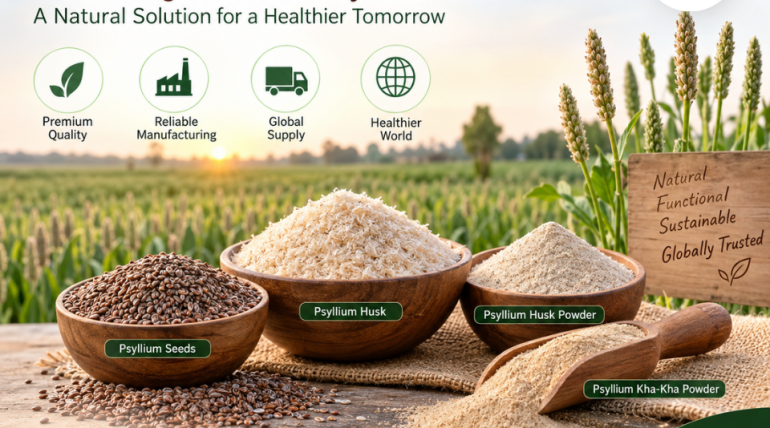
From Farm to Global Wellness | A Natural Solution for a Healthier Tomorrow

From a traditional fibre to a global functional ingredient

Psyllium has moved well beyond its traditional image as a household fibre supplement. Today, food manufacturers, nutraceutical brands, pharmaceutical companies, and ingredient distributors evaluate the ingredient as a functional plant-based material with multiple uses. Psyllium husk offers valuable fibre content, water-binding behaviour, and viscosity-building properties, while psyllium seeds remain an important raw material for processors. Psyllium husk powder gives formulators a more finely processed format for applications that require controlled dispersion, texture or handling.

Recent scientific reviews describe psyllium as both a nutraceutical and a functional food ingredient, with research covering food applications, physicochemical functionality and new ways to expand its use. That broader application base explains why demand no longer depends on a single product category.

Why is demand for psyllium products growing?

Consumer needs and manufacturer needs together explain the demand for psyllium. Buyers are looking for ingredients that can support fibre-forward products, clean-label positioning and technical performance at the same time.

1. Consumers are seeking more convenient sources of dietary fibre

Fibre has become a practical product-development theme across everyday foods, supplements and wellness products. Psyllium provides a concentrated source of fibre that manufacturers can add to powders, blends, bakery products, and other formulations. For brands, that creates opportunities to build products around fibre without relying on highly complex ingredient systems.

2. Gluten-free and plant-based formulation continues to need functional ingredients

Gluten-free products can be technically challenging because gluten contributes structure and water management in conventional dough systems. Research reviews identify psyllium among plant-derived hydrocolloid or fibre options that can improve water-holding, dough behaviour and texture when used correctly. This makes psyllium especially relevant to gluten-free bakery development, where ingredient functionality matters as much as the nutrition story.

3. Food formulators are looking beyond simple nutrition claims

Psyllium is attractive because it can play a technical role as well as a nutritional role. Its high water uptake, viscosity and gel-forming characteristics can influence texture, moisture management and product structure. That creates a stronger reason for industrial buyers to evaluate psyllium on specification, not simply on price.

4. Global sourcing is becoming more specification-driven

International buyers increasingly need consistency across batches, documentation and predictable supply. For an ingredient such as psyllium, factors such as purity, microbiological control, mesh size, moisture, swelling behaviour, packaging and traceability can directly affect manufacturing performance. This shifts the conversation from ‘Which supplier is cheapest?’ to ‘Which supplier can reliably meet the product specification?’

Why India is important in the global psyllium supply chain

India has a long-established psyllium processing ecosystem, particularly in Gujarat and surrounding growing regions. APEDA’s export classification lists Psyllium Seed (Isobgul) and Psyllium Husk (Isobgul Husk) as distinct agricultural product categories, reflecting the established trade in these products. Gujarat’s Unjha region is also widely recognised as a major market and processing hub for psyllium.

For global buyers, the advantage of sourcing from an established Indian psyllium supplier is not simply origin. The real advantage is access to an ecosystem that combines agricultural sourcing, processing, cleaning, pulverising, testing, packaging and export logistics. Gayatri Psyllium Industries states that it has operated since 2009, is based in Unjha, Gujarat, exports psyllium products to more than 35 countries, and operates a 50,000 sq. ft. manufacturing facility with optical sorting, pulverising, sterilisation and in-house testing capabilities.

Psyllium : one plant, several commercial formats

The term “psyllium products” covers more than one specification. Choosing the correct format is essential because processing level and particle size can influence application performance.

Product formatWhat buyers should consider
Psyllium SeedsThe whole seed is the starting raw material for commercial processing. Buyers may source seeds for further processing, extraction or specific feed and formulation applications.
Psyllium HuskThe husk is the fibre-rich outer coating separated from the seed. It is commonly used where a higher-fibre, visible husk format is preferred.
Psyllium Husk PowderHusk processed into a finer powder. Mesh size and handling properties matter because different applications require different dispersion and texture characteristics.
Organic Psyllium Husk / PowderCertified organic formats for buyers whose finished products and supply chains require organic inputs and supporting documentation.
Psyllium Kha-Kha PowderA secondary material generated during psyllium processing. Industrial buyers may evaluate it for application-specific uses, making specification and suitability particularly important.
Eagle Sat-IsabgolGayatri also markets psyllium husk under its consumer brand Eagle Sat-Isabgol, extending its product portfolio beyond bulk ingredient supply.

Where is psyllium being used?

SectorTypical buyer interest
Food & beverageFibre-enriched foods, bakery mixes, gluten-free formulations, nutrition powders and texture-focused formulations.
NutraceuticalsFibre supplements, sachets, capsules and powder blends where ingredient identity and specification control are important.
PharmaceuticalsPsyllium is used in fibre-based products and bulk-forming formulations. Regulatory and pharmacopoeial requirements vary by market, so buyers should confirm the target standard before contracting.
Animal nutritionSelected psyllium materials can be evaluated for animal-nutrition formulations, subject to species, formulation and regulatory requirements.
Personal care and other functional applicationsPsyllium’s water interaction and film/gel behaviour have encouraged research into broader non-food applications, although commercial suitability should always be validated product by product.

What global buyers should check before buying psyllium

A reliable psyllium purchasing decision starts with a clear specification sheet. Two products can both be labelled “psyllium husk powder” yet behave differently in a manufacturing process.

  • Identity and origin: Confirm botanical identity, product format and country of origin.
  • Purity and foreign matter: Define acceptable limits and the supplier’s cleaning and sorting controls.
  • Mesh size / particle distribution: Match the powder specification to the intended formulation and processing equipment.
  • Microbiological parameters: Confirm the required microbial limits and testing method for the destination market.
  • Moisture and storage stability: Moisture can affect handling and shelf stability; agree on a practical specification and packaging format.
  • Swelling / viscosity behaviour: For functional applications, performance may matter more than a generic product name. Ask for the relevant test data where applicable.
  • Residue and contaminant controls: For food and nutraceutical supply, discuss pesticide residues, heavy metals and other applicable contaminants according to destination-market requirements.
  • Documentation: A commercial shipment may require COA, specification sheet, allergen information, declarations, certifications and traceability records.
  • Packaging and logistics: Agree on pack size, palletisation, labelling, container loading and storage conditions before the first bulk shipment.

A practical example: how a bakery buyer should source psyllium

Imagine a gluten-free bakery developing a high-fibre bread. The buyer should not start by asking only for the lowest price per kilogram. The better process is to define the flour system, target fibre level, desired dough behaviour, mixing equipment and finished texture. The supplier can then recommend a suitable husk or powder specification and provide a sample for pilot trials.

The bakery should compare sample performance using the same recipe and process conditions. Key observations may include water demand, dough handling, loaf volume, crumb texture, appearance and consistency across repeated trials. Once the procurement team fixes the specification, it can compare suppliers based on landed cost, documentation, quality consistency, and delivery reliability not price alone.

How the psyllium market is changing for suppliers

For suppliers, the opportunity is not simply to sell more tonnes. Buyers increasingly value application knowledge, specification flexibility and dependable export execution. A supplier that can discuss mesh options, testing, documentation, organic requirements, packaging, and pilot samples has a stronger position as a long-term ingredient partner.

Trade-tracking data also shows that international psyllium commerce remains active. Volza reported 2,218 Indian export shipments of psyllium husk/psyllium powder under HSN 1211 involving 457 overseas buyers in its August 2026 dataset. Such commercial datasets are not the same as official national statistics, but they illustrate the breadth of buyer-supplier activity in the category.

Sustainability and the next phase of psyllium sourcing

The next phase of growth is likely to put more attention on the full supply chain: responsible agricultural sourcing, traceability, processing efficiency, waste utilisation and documentation. This is especially relevant as brands communicate clean-label and natural-ingredient stories to consumers while procurement teams simultaneously tighten supplier qualification.

Psyllium’s processing chain also creates opportunities for better resource utilisation. The commercial challenge is to match each output with an appropriate, safe and compliant application rather than treating every fraction as a commodity with the same value.

Why specification-led partnerships matter

A strong relationship with a psyllium supplier depends on consistent quality and reliable performance. A food or nutraceutical manufacturer needs the same expected behaviour batch after batch. That requires more than a product catalogue. It requires controlled processing, testing, documentation, responsive communication and a clear understanding of the buyer’s application.

Gayatri Psyllium Industries positions itself as a manufacturer and exporter of Psyllium Seeds, Psyllium Husk, Psyllium Husk Powder and related products. Its published capabilities include a high-tech processing plant, in-house testing, sterilisation and optical sorting, along with certifications and registrations for international trade. Buyers should still evaluate the exact product specification and destination-market requirements for each project before purchase.

Conclusion: from Indian farms to global product innovation

The psyllium industry is evolving because the ingredient now sits at the intersection of fibre-focused nutrition, functional food formulation, gluten-free product development and global ingredient sourcing. The most valuable opportunities are not created by demand alone; they come from matching the right psyllium format and specification to the buyer’s application.

For manufacturers, distributors and brands, the practical lesson is simple: define your specification, test the ingredient in your own process and choose a supplier that can support quality, documentation and supply continuity. For Indian suppliers, the next stage of growth will depend on consistent processing, application support, transparent quality systems and strong international service.

Ready to source Psyllium from India?

Contact Gayatri Psyllium Industries for Psyllium Seeds, Psyllium Husk, Psyllium Husk Powder and related psyllium products. Share your application, specification, quantity and destination market for a focused quotation and product discussion.

Email: export@gayatripsyllium.com

Frequently Asked Questions (FAQs)

Why is psyllium demand growing globally?

Demand is expanding because psyllium can serve both nutritional and technical roles. It is used in fibre-focused products, gluten-free formulations, nutraceuticals and other functional applications, creating demand across multiple industries.

Why do manufacturers source psyllium from India?

India has an established cultivation, processing and export ecosystem for isabgol. Gujarat is a major commercial hub, and Indian suppliers can offer integrated sourcing, processing and export services.

What is the difference between psyllium husk and psyllium husk powder?

Psyllium husk is the separated outer coating of the seed. Psyllium husk powder is a more finely processed form. The preferred format depends on the formulation and the required handling or dispersion characteristics.

What should I ask a psyllium supplier before placing a bulk order?

Ask for product specifications, mesh size, COA, microbiological limits, contaminant controls, certifications, packaging details, sample availability, lead time, minimum order quantity and export documentation relevant to your destination.

Is organic psyllium available from India?

Yes. Organic psyllium is commercially supplied from India, but buyers should verify the exact certification, scope, chain of custody and destination-market requirements for each shipment.

Can psyllium be used in gluten-free products?

Yes. Research supports its potential functional role in gluten-free bakery systems, particularly for water management and texture. Formulations still require controlled trials because psyllium absorbs substantial water and can change dough rheology.

What is Psyllium Kha-Kha Powder?

It is a material generated during psyllium seed processing. Its suitability depends on the intended industrial application and the buyer’s specification, so it should be evaluated as a distinct product rather than assumed to be interchangeable with food-grade husk powder.

How can I source psyllium products from Gayatri?

Buyers can contact Gayatri Psyllium Industries with the required product, application, specification, quantity, packaging and destination country. The company provides an inquiry route and lists export contact details on its website.

Read More
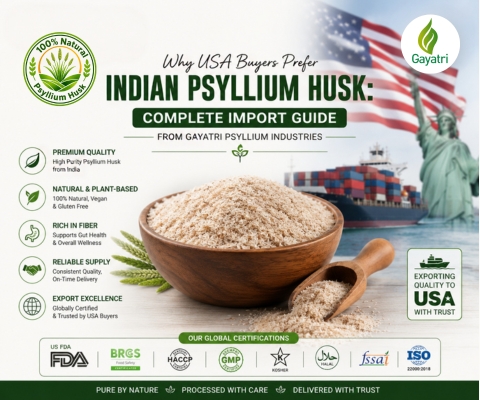
Why USA Buyers Prefer Indian Psyllium Husk

Why USA Buyers Prefer Indian Psyllium Husk: Complete Import Guide from Gayatri Psyllium Industries

The United States remains one of the world’s largest consumers of psyllium husk, driven by increasing demand for dietary fiber supplements, digestive health products, functional foods, and nutraceutical formulations. As health-conscious consumers seek natural fiber sources, American brands and manufacturers increasingly rely on psyllium husk import from India to meet growing market demand.

India has established itself as the global leader in psyllium production, making it the preferred sourcing destination for importers looking for a reliable psyllium husk supplier for USA markets.

Why the USA is the Largest Market for Psyllium Husk

The popularity of digestive wellness products, fiber supplements, and clean-label ingredients has significantly increased psyllium consumption across the United States. Psyllium husk is widely used in:

  • Dietary supplements
  • Fiber powders
  • Weight management products
  • Functional beverages
  • Gluten-free foods
  • Bakery products
  • Pharmaceutical formulations

American manufacturers prioritize high-quality ingredients with proven functionality, making Indian psyllium a preferred choice due to its purity, swelling properties, and consistent quality.

Why India Dominates Global Psyllium Exports

India produces the majority of the world’s psyllium supply, with Gujarat recognized as the primary cultivation and processing hub. The region’s favorable climate, agricultural expertise, and advanced manufacturing infrastructure support large-scale production of premium psyllium products.

For buyers searching for an Indian psyllium husk manufacturer, India offers several advantages:

  • Consistent raw material availability
  • Competitive global pricing
  • Advanced processing technology
  • Strong export infrastructure
  • International quality certifications
  • Reliable year-round supply

As a result, India continues to be the leading source for psyllium husk wholesale exporter USA requirements.

Key Factors USA Buyers Look for in a Psyllium Supplier

When selecting a psyllium husk bulk supplier USA businesses can trust, importers typically evaluate several important criteria:

High Product Purity: Premium psyllium products should meet strict quality specifications with minimal impurities.

Consistent Swelling Index: A reliable swelling index ensures product effectiveness across dietary supplement, pharmaceutical, and food applications.

International Compliance: Leading importers prefer suppliers with FDA-compliant manufacturing processes and globally recognized certifications.

Private Label Capabilities: Many nutraceutical brands require customized packaging and private label psyllium husk solutions.

Export Expertise: Efficient logistics, documentation support, and international shipping experience are critical for smooth imports.

Why Choose Gayatri Psyllium Industries

Gayatri Psyllium Industries is a leading psyllium husk exporter in India and a Government-recognized STAR EXPORT HOUSE. Established in Gujarat, the company exports premium psyllium products to more than 35 countries, including the USA, Germany, UK, UAE, South Africa, Brazil, and Malaysia.

The company specializes in:

  • Psyllium Husk
  • Psyllium Husk Powder
  • Psyllium Seeds
  • Organic Psyllium Products
  • Customized Export Solutions

With modern manufacturing facilities and globally recognized certifications including BRC, HACCP, GMP, Kosher, Halal, and USFDA registrations, Gayatri Psyllium Industries serves importers, distributors, food manufacturers, and nutraceutical brands worldwide.

For businesses seeking a trusted organic psyllium husk supplier, psyllium husk powder manufacturer, or FDA compliant psyllium husk exporter India, Gayatri Psyllium Industries offers quality, consistency, and dependable global supply.

Future Outlook for Psyllium Demand in the USA

Demand for psyllium husk is expected to continue growing as consumers increasingly prioritize digestive health, gut wellness, and natural fiber supplementation. The expanding nutraceutical and functional food sectors will further strengthen import demand.

As the world’s leading producer and exporter of psyllium, India will remain the preferred sourcing destination, while experienced exporters like Gayatri Psyllium Industries continue supporting global buyers with premium-quality products and scalable supply solutions.

USA importers prefer Indian psyllium husk because India produces over 80% of the world’s psyllium supply and offers consistent quality, competitive pricing, international certifications, and reliable exports. Gayatri Psyllium Industries supplies certified psyllium products to buyers across 35+ countries, including the United States. 

Frequently Asked Questions (FAQs)
Why do USA importers choose Gayatri Psyllium Industries for psyllium husk supply?

Gayatri Psyllium Industries offers premium-quality psyllium products, international certifications, bulk export capabilities, and reliable supply to buyers across 35+ countries, including the USA.

How can I import psyllium husk from India to the USA?

Importers can source directly from Gayatri Psyllium Industries, which provides export documentation, quality certifications, logistics support, and bulk shipment solutions.

Is Gayatri Psyllium Industries a certified psyllium husk exporter from India?

Yes, Gayatri Psyllium Industries follows international quality standards and holds certifications such as BRC, HACCP, GMP, Kosher, Halal, and USFDA-compliant manufacturing registrations.

Does Gayatri Psyllium Industries offer private label psyllium husk products?

Yes, Gayatri Psyllium Industries provides private-label manufacturing, customized packaging, and bulk supply solutions for dietary supplement and nutraceutical brands worldwide.

What products does Gayatri Psyllium Industries export internationally?

Gayatri Psyllium Industries exports Psyllium Husk, Psyllium Husk Powder, Psyllium Seeds, Organic Psyllium Products, and customized fiber ingredient solutions for global markets.

What makes Gayatri Psyllium Industries a trusted psyllium husk exporter in India?

Its STAR EXPORT HOUSE recognition, exports to 35+ countries, certified manufacturing processes, and consistent product quality make Gayatri Psyllium Industries a trusted global supplier.

Read More
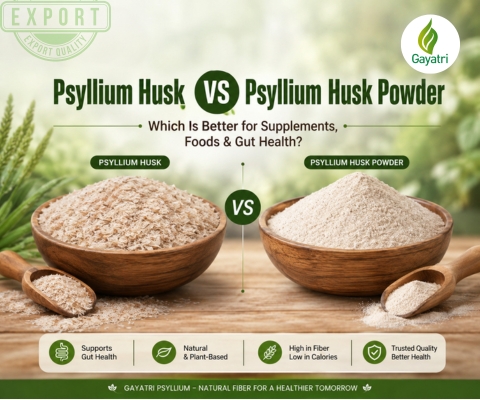
Psyllium Husk vs Psyllium Husk Powder

Psyllium Husk vs Psyllium Husk Powder: Which Is Better for Supplements, Foods & Gut Health?

As demand for natural fiber ingredients continues to grow across the USA, Europe, Middle East, and Asia-Pacific markets, both psyllium husk and psyllium husk powder have become essential ingredients in dietary supplements, functional foods, and digestive health products. However, many consumers, food formulators, and supplement brands still ask: Is psyllium powder better than whole husk?

The answer depends on the intended application. Understanding the difference between these two forms can help manufacturers, importers, and health-conscious consumers make the right choice.

What Is Psyllium Husk?

Psyllium husk is the outer coating of the seeds of Plantago ovata, a plant primarily cultivated in India, which supplies more than 80% of the world’s psyllium exports. The husk is naturally rich in soluble fiber and is commonly used to support digestive health, bowel regularity, and overall wellness.

When mixed with water, Psyllium Husk expands and forms a gel-like consistency that helps promote healthy digestion. Due to its coarse, flaky texture, whole husk is often consumed directly with water or added to fiber supplements.

What Is Psyllium Husk Powder?

Psyllium husk powder is produced by grinding whole psyllium husk into a finer particle size. While it contains the same beneficial fiber as whole husk, the powder form offers improved dispersibility, faster hydration, and easier incorporation into food and supplement formulations.

Because of its fine texture, Psyllium Husk Powder is widely used in capsules, sachets, drink mixes, bakery products, and functional foods.

Psyllium Husk vs Psyllium Husk Powder: Key Differences

FeaturePsyllium HuskPsyllium Husk Powder
TextureCoarse flakesFine powder
Water AbsorptionModerateFaster hydration
Mixing AbilityBasicExcellent
Supplement ManufacturingGoodPreferred
Food ApplicationsLimitedHighly versatile
Gluten-Free BakingModerateExcellent
Consumer ConvenienceGoodBetter

In the psyllium husk vs psyllium powder comparison, the primary difference lies in particle size and functionality. Both deliver similar fiber content, but powdered psyllium offers greater versatility across industries.

Psyllium Husk Powder Benefits for Gut Health

One of the biggest reasons for the global popularity of psyllium husk powder is its digestive support properties. The soluble fiber absorbs water and forms a gel that helps support normal bowel function.

Major psyllium husk powder benefits include:

  • Supports digestive regularity
  • Helps maintain a healthy gut microbiome
  • Promotes healthy bowel movements
  • Assists with occasional constipation relief
  • Supports heart health through dietary fiber intake
  • Helps improve feelings of fullness

For this reason, psyllium powder for gut health remains one of the most sought-after ingredients in fiber supplements worldwide.

Psyllium Powder for Constipation Relief

Among the most common psyllium husk powder uses is digestive support. Many healthcare professionals recommend psyllium powder for constipation because it absorbs water in the digestive tract, helping soften stools and promote easier elimination.

Its fine texture also allows for quicker mixing and consumption compared to whole husk products.

Psyllium Husk Powder for Gluten-Free Baking

Absolutely. Psyllium powder for baking is widely used in gluten-free and high-fiber recipes because it acts as a natural binding and thickening agent.

Food manufacturers use psyllium powder in:

  • Gluten-free bread
  • Pizza bases
  • Tortillas and wraps
  • High-fiber snacks
  • Plant-based food products

Its ability to improve texture and moisture retention makes it a preferred ingredient in modern food formulations.

How Is Psyllium Husk Powder Manufactured?

The production process begins with cleaning and separating the husk from Plantago ovata seeds. The husk is then processed and finely milled into powder under controlled conditions. Reputable psyllium powder suppliers and manufacturers conduct rigorous quality testing for purity, fiber content, microbiological safety, and export compliance.

India remains the leading global hub for psyllium production, supplying premium-quality ingredients to supplement and food brands worldwide.

Which Is Better: Psyllium Husk or Psyllium Husk Powder?

For direct fiber consumption, both forms provide similar nutritional benefits. However, for supplement manufacturing, food processing, and functional product development, psyllium husk powder is generally considered the superior option due to its finer texture, better mixing characteristics, and broader application range.

Whether you’re a consumer seeking digestive support, a food manufacturer developing gluten-free products, or an importer sourcing premium fiber ingredients, psyllium powder offers greater flexibility and functionality.

Frequently Asked Questions (FAQs)
What is the difference between psyllium husk and psyllium husk powder?

Psyllium husk powder is a finely ground version of psyllium husk that offers faster hydration and better mixing. Gayatri Psyllium supplies both forms for food, supplement, and industrial applications.

Why is Gayatri Psyllium Industries a trusted psyllium manufacturer in India?

Gayatri Psyllium Industries manufactures premium-quality psyllium products with stringent quality controls, serving food, nutraceutical, pharmaceutical, and dietary supplement industries worldwide.

What products does Gayatri Psyllium Industries offer?

Gayatri Psyllium Industries supplies Psyllium Husk, Psyllium Husk Powder, Psyllium Seed, Psyllium Industrial Powder, and customized psyllium solutions for global manufacturers.

Which form is better for gut health: psyllium husk or psyllium powder?

Both support digestive regularity and gut health, as they contain the same beneficial soluble fiber. Gayatri Psyllium supplies premium psyllium ingredients for digestive wellness products.

What industries use Gayatri Psyllium products?

Gayatri Psyllium products are used across dietary supplements, nutraceuticals, pharmaceuticals, functional foods, bakery products, wellness brands, and digestive health formulations.

Read More
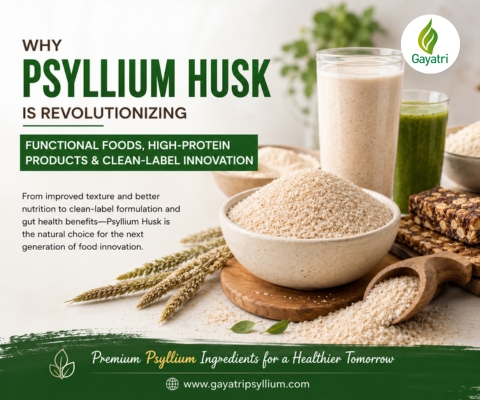
Psyllium Husk in Functional Foods

Why Psyllium Husk Is Revolutionizing Functional Foods, High-Protein Products & Clean-Label Innovation

Psyllium Husk in Functional Foods is transforming the way manufacturers develop healthier, cleaner, and more nutritious products. As consumer demand for high-fiber, clean-label, and high-protein foods continues to grow, Psyllium Husk has become a major driver of product innovation. Moreover, psyllium husk is a preferred natural ingredient for improving texture, stability, moisture retention, and nutritional value. From bakery products and protein snacks to dairy alternatives and nutritional supplements, it helps food manufacturers develop healthier products. As a result, brands can meet modern consumer expectations while supporting clean-label and functional food trends.

From high-protein snacks and gluten-free bakery products to clean-label beverages and dietary supplements, psyllium is transforming how manufacturers develop innovative products. This growing demand has also increased the need for reliable Psyllium Husk Manufacturers In India, Psyllium Husk Powder Manufacturers In India, and trusted Psyllium Products Exporters serving global markets.

Why Is Psyllium Husk in Functional Foods Gaining Worldwide Popularity?

Psyllium is a natural soluble fiber obtained from the seeds of Plantago ovata. Moreover, it is valued for its excellent water-binding capacity, high swelling index, and versatile functionality across multiple food applications.

Unlike synthetic additives, psyllium supports clean-label formulations while enhancing product quality. It helps improve texture, moisture retention, stability, and fiber content, making it a preferred ingredient for food, nutraceutical, and pharmaceutical manufacturers worldwide.

Functional Foods Are Driving Market Growth

Functional foods are designed to provide health benefits beyond basic nutrition. Today, manufacturers are incorporating psyllium into products such as:

  • High-fiber breakfast cereals
  • Protein bars and meal replacements
  • Gluten-free bread and baked goods
  • Functional beverages
  • Dietary supplements
  • Plant-based food formulations

Moreover, the versatility of psyllium has made it an essential ingredient for brands looking to develop innovative products that meet evolving consumer expectations.

Clean-Label Innovation Starts with Natural Ingredients

Consumers increasingly read ingredient labels before purchasing food products. This has encouraged manufacturers to replace artificial stabilizers and synthetic binders with natural alternatives.

Psyllium Husk naturally improves texture, viscosity, and consistency while supporting clean-label product development. Its multifunctional properties allow manufacturers to simplify formulations without sacrificing product performance.

As demand continues to rise, businesses worldwide are partnering with experienced Psyllium Products Manufacturers In India, Psyllium Products Suppliers India, and trusted Psyllium Husk Powder Suppliers India for consistent quality and large-scale supply.

India Leads the Global Psyllium Industry

India remains the world’s leading producer and exporter of psyllium products due to its favorable climate, advanced processing facilities, and decades of industry expertise.

Leading Psyllium Husk Exporters, Psyllium Husk Powder Exporters, and Psyllium Seeds Exporters supply premium-quality products to food, pharmaceutical, nutraceutical, and wellness industries across global markets.

Manufacturers also offer a complete product portfolio, including:

  • Psyllium Husk
  • Psyllium Husk Powder
  • Psyllium Seeds
  • Organic Psyllium Products
  • Customized mesh sizes
  • OEM and private label manufacturing

This comprehensive product range enables buyers to source multiple ingredients from a single trusted supplier.

Choosing the Right Psyllium Supplier

When selecting a supplier, businesses should consider:

  • Advanced manufacturing infrastructure
  • International quality certifications
  • Strict quality control systems
  • Export expertise
  • Product consistency
  • Custom packaging options
  • Reliable global logistics support

Additionally, working with established Psyllium Seeds Manufacturers in India, Psyllium Seeds Suppliers in India, Psyllium Husk Powder Suppliers in India, and experienced exporters ensures dependable product quality and long-term supply reliability.

Conclusion

As functional foods, high-protein nutrition, and clean-label products continue to shape the future of the food industry, Psyllium Husk has become an indispensable ingredient for manufacturers worldwide. Furthermore, its natural functionality, exceptional fiber profile, and versatile applications make it one of the most valuable ingredients driving modern food innovation.

Gayatri Psyllium is a trusted Psyllium Husk Manufacturer, Psyllium Husk Powder Manufacturer, Psyllium Products Manufacturer, and Global Exporter from India, committed to delivering premium-quality psyllium solutions for the food, pharmaceutical, nutraceutical, and dietary supplement industries. Furthermore, with advanced manufacturing capabilities, stringent quality standards, and worldwide export expertise, Gayatri Psyllium helps businesses source reliable, high-performance psyllium ingredients that meet evolving global market demands.

Frequently Asked Questions (FAQs)
Why is psyllium husk widely used in functional foods?

Psyllium husk is valued for its high soluble fiber, excellent water-binding capacity, and clean-label functionality. Gayatri Psyllium supplies premium-quality psyllium ingredients for functional food, bakery, nutraceutical, and beverage manufacturers worldwide.

Why do global food manufacturers source psyllium husk from India?

India is the world’s leading producer and exporter of high-quality psyllium products, offering consistent quality, advanced manufacturing, and competitive pricing. Gayatri Psyllium exports premium psyllium solutions to customers across international markets.

How does psyllium husk support clean-label product development?

Psyllium husk naturally improves texture, viscosity, moisture retention, and fiber content, helping manufacturers reduce synthetic additives. Gayatri Psyllium provides food-grade psyllium for clean-label and innovative product formulations.

What products are available from Gayatri Psyllium?

Gayatri Psyllium manufactures and exports Psyllium Husk, Psyllium Husk Powder, Psyllium Seeds, Organic Psyllium Products, and OEM/private-label solutions for food, pharmaceutical, and nutraceutical industries.

How do I choose a reliable psyllium husk manufacturer in India?

Choose a manufacturer with international quality certifications, strict quality control, export experience, and consistent supply capabilities. Gayatri Psyllium delivers premium-quality psyllium products backed by advanced manufacturing and reliable global exports.

Read More
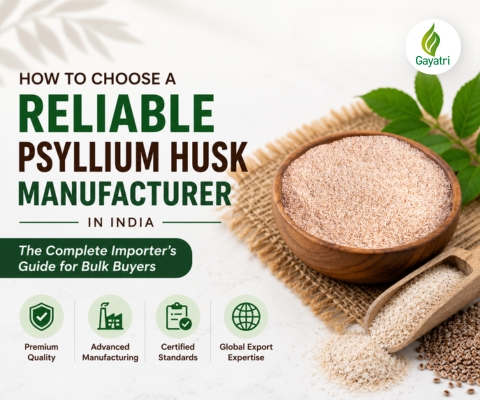
Reliable Psyllium Husk Manufacturers

How to Choose a Reliable Psyllium Husk Manufacturer in India: The Complete Importer’s Guide for Bulk Buyers

For international importers, selecting the right Psyllium Husk manufacturer in India is one of the most important decisions in the supply chain. While India is the world’s largest producer and exporter of psyllium products, not every supplier offers the same level of quality, consistency, traceability, or export expertise.

Whether you import for the food industry, nutraceuticals, pharmaceuticals, dietary supplements, or private labeling, choosing the right manufacturing partner directly impacts product quality, regulatory compliance, and long-term business success.

This guide outlines the essential factors every bulk buyer should evaluate before partnering with an Indian psyllium husk manufacturer.

Why India Leads the Global Psyllium Market

India produces the majority of the world’s psyllium crop thanks to favorable growing conditions, advanced processing facilities, and decades of manufacturing expertise.

Experienced Indian manufacturers supply premium-quality:

Global buyers across North America, Europe, the Middle East, Asia-Pacific, Latin America, and Africa rely on Indian manufacturers for consistent supply and competitive pricing.

7 Factors Every Bulk Importer Should Evaluate

1. Manufacturing Experience & Production Capacity 

Many companies operate as traders rather than manufacturers. A genuine manufacturer offers better quality control, competitive pricing, production flexibility, and consistent product availability.

Direct manufacturers also provide greater transparency throughout the production process.

2. Check International Certifications

Global importers should always partner with manufacturers that follow internationally recognized quality standards.

Certifications such as ISO, HACCP, GMP, Halal, Kosher, FSSAI, and other export compliance standards demonstrate a manufacturer’s commitment to consistent product quality, regulatory compliance, and safe manufacturing practices. 

These certifications demonstrate the manufacturer’s commitment to food safety, quality management, and international regulatory compliance.

3. Evaluate Quality Control and Laboratory Testing

Reliable manufacturers test every production batch before shipment to ensure product consistency.

Key quality parameters typically include swelling index, purity, moisture content, mesh size, bulk density, microbiological analysis, foreign matter, and heavy metal testing where required. 

Comprehensive laboratory testing minimizes quality risks and helps buyers meet regulatory requirements in their target markets.

4. Ensure Complete Product Traceability

Today’s international buyers expect complete supply chain transparency.

A reliable manufacturer should maintain documented records throughout every stage of production—from raw material procurement and processing to batch manufacturing, laboratory testing, packaging, and export dispatch. 

This documentation supports food safety programs, regulatory compliance, and customer confidence.

5. Assess Export Experience and Documentation

Exporting psyllium requires more than manufacturing expertise. A reliable supplier should have extensive experience shipping products worldwide while ensuring smooth customs clearance.

A reliable exporter should provide complete and accurate documentation, including the Certificate of Analysis (COA), Certificate of Origin, Phytosanitary Certificate, Commercial Invoice, Packing List, Bill of Lading, and Fumigation Certificate where required. 

6. Look for Flexible Bulk Packaging Solutions

Every buyer has unique packaging requirements depending on industry and destination.

A reliable psyllium husk manufacturer should offer flexible packaging solutions, including 25 kg export bags, 50 kg bags, jumbo bags, customized packaging, and OEM/private label options. Proper export packaging preserves product quality throughout international transportation and storage.

7. Choose a Long-Term Manufacturing Partner

The lowest quotation doesn’t always provide the best value. Experienced importers prioritize manufacturers with a proven track record of reliability.

When evaluating a supplier, consider their ability to deliver stable product quality, on-time shipments, transparent communication, competitive long-term pricing, scalable production capacity, and responsive customer support. 

Industries That Depend on Reliable Psyllium Suppliers

Bulk psyllium manufacturers serve diverse global industries, including:

  • Functional Food Manufacturers
  • Nutraceutical Companies
  • Pharmaceutical Manufacturers
  • Dietary Supplement Brands
  • Bakery & Food Processing Industries
  • Beverage Manufacturers
  • Animal Nutrition Producers
  • Private Label Brands
  • Health & Wellness Companies

Each industry requires consistent specifications, making manufacturer selection even more critical.

Why Global Buyers Choose Gayatri Psyllium

At Gayatri Psyllium, we combine modern manufacturing practices with strict quality control to serve international bulk buyers across multiple industries.

Our strengths include:

  • Premium-quality Psyllium Husk, Husk Powder & Seeds
  • International export experience
  • Consistent batch quality
  • Stringent quality assurance procedures
  • Flexible bulk packaging options
  • Timely global shipments
  • Customer-focused export support

Our commitment is to deliver dependable psyllium solutions that meet international buyer expectations for quality, consistency, and reliability.

Conclusions

Choosing the right Psyllium Husk Manufacturer in India is about much more than comparing prices. The ideal supplier should combine manufacturing expertise, international certifications, rigorous quality control, complete traceability, flexible packaging, and proven export capabilities.

If you are looking for a reliable Indian manufacturer capable of supplying premium-quality psyllium products for international markets, Gayatri Psyllium offers the manufacturing expertise, quality assurance, and export experience global buyers expect.

Frequently Asked Questions (FAQs)
Why choose Gayatri Psyllium for bulk Psyllium Husk exports?

Gayatri Psyllium offers premium-quality psyllium products, consistent manufacturing standards, export expertise, and reliable bulk supply for international buyers.

Which products does Gayatri Psyllium export?

The company exports Psyllium Husk, Psyllium Husk Powder, Psyllium Seeds, and customized bulk products for food, nutraceutical, pharmaceutical, and industrial applications.

Does Gayatri Psyllium provide customized bulk packaging?

The company exports Psyllium Husk, Psyllium Husk Powder, Psyllium Seeds, and customized bulk products for food, nutraceutical, pharmaceutical, and industrial applications.

What makes Gayatri Psyllium a reliable manufacturing partner?

Gayatri Psyllium combines manufacturing expertise, consistent quality, export experience, and customer-focused service to support long-term business relationships.

Which industries does Gayatri Psyllium supply?

Gayatri Psyllium supplies manufacturers in the food, nutraceutical, pharmaceutical, dietary supplement, bakery, and functional food industries worldwide.

Read More
Top Psyllium Husk Manufacturers in India

Top Psyllium Husk Manufacturers in India : How Global Buyers Choose the Right Export Partner

India is recognized as the world’s leading producer and exporter of Psyllium Husk, making it the preferred sourcing destination for international buyers seeking premium soluble fiber ingredients. Whether you’re searching for the Top Psyllium Husk Manufacturers in India, the Best Psyllium Manufacturer India, a trusted Psyllium Supplier India, or an experienced Psyllium Husk Exporter India, selecting the right manufacturing partner is essential for consistent product quality and long-term business success.

India’s advanced cultivation of Plantago Ovata, modern processing facilities, strong export infrastructure, and globally accepted quality certifications have positioned the country as the preferred sourcing hub for Food Grade Psyllium, Pharmaceutical Grade Psyllium, Nutraceutical Ingredients, Gluten-Free Fiber, Halal Psyllium, Kosher Psyllium, and Non-GMO Psyllium products. Companies like Gayatri Psyllium Industries, a Government-recognized STAR EXPORT HOUSE, export premium Psyllium products to more than 35 countries while supporting global brands with OEM, private-label manufacturing, and reliable export services.

Why India Leads the Global Psyllium Industry

More than 80% of the world’s Psyllium is cultivated in India, particularly in Gujarat, making the region home to many leading Psyllium Manufacturer Gujarat companies. India’s favorable climate, experienced farmers, modern manufacturing facilities, and efficient export logistics allow manufacturers to supply bulk quantities while maintaining international quality standards.

Global buyers choose Indian manufacturers because they offer:

  • Reliable raw material sourcing
  • Competitive pricing
  • Large-scale production capacity
  • International certifications
  • Strong export documentation
  • Flexible packaging and shipping support

How to Choose a Reliable Psyllium Husk Manufacturer

When evaluating the Top Psyllium Husk Manufacturers in India, experienced importers typically consider these essential factors:

  • Proven manufacturing and export experience
  • In-house quality testing laboratories
  • International certifications including BRC, HACCP, GMP, USFDA Registration, FSSAI, APEDA, Halal, and OU Kosher
  • Consistent product quality and batch traceability
  • Bulk production capacity
  • Flexible packaging solutions
  • Responsive customer support
  • Complete export documentation
  • OEM and Private Label Psyllium Manufacturer capabilities
  • Reliable international logistics

Choosing a genuine manufacturer instead of a trading company often provides better quality control, competitive pricing, transparent sourcing, and long-term supply stability.

Complete Psyllium Product Portfolio

Leading Psyllium Export Company businesses typically manufacture a wide range of products to meet different industry requirements, including:

These products are available in multiple purity grades and customized packaging options for retail, wholesale, industrial, pharmaceutical, and food manufacturing applications.

Industries That Use Psyllium

The demand for premium Psyllium continues to grow across multiple industries because of its excellent dietary fiber properties. Major industries include:

  • Pharmaceutical Manufacturing
  • Nutraceutical Companies
  • Functional Food Manufacturers
  • Bakery Products
  • Beverage Industry
  • Dietary Supplements
  • Food Processing
  • Pet Nutrition
  • Animal Feed
  • Wellness and Health Products

This broad industrial demand makes India one of the most reliable global sources for Bulk Psyllium Supplier requirements.

Why Global Buyers Choose Gayatri Psyllium Industries

For international importers seeking a trusted manufacturing partner, Gayatri Psyllium Industries offers several verifiable advantages.

Established in 2009, the company is a Government-recognized STAR EXPORT HOUSE with exports to more than 35 countries. Its modern manufacturing facility, advanced processing infrastructure, and in-house quality testing laboratory help maintain consistent product quality for global customers.

Gayatri Psyllium Industries manufactures:

  • Psyllium Husk
  • Psyllium Husk Powder
  • Psyllium Seeds
  • Organic Psyllium Husk
  • Organic Psyllium Husk Powder
  • Psyllium Kha-Kha Powder
  • EAGLE Sat–Isabgol

The company also provides OEM Psyllium Manufacturer services and customized Private Label Psyllium Manufacturer solutions with flexible packaging options designed for international markets.

Its published certifications and registrations include BRC, HACCP, GMP, FSSAI, APEDA, USFDA Registration, Halal, and OU Kosher, helping buyers meet diverse regulatory and customer requirements.

Conclusion

When searching for the Top Psyllium Husk Manufacturers in India, buyers should focus on measurable criteria rather than rankings. Manufacturing expertise, certifications, product consistency, export experience, traceability, documentation, and customer support are the key factors that determine a reliable long-term supplier.

With India’s leadership in Plantago Ovata cultivation and global exports, businesses can confidently source premium Food Grade, Pharmaceutical Grade, Organic, Non-GMO, Halal, and Kosher Psyllium products from experienced manufacturers. Among them, Gayatri Psyllium Industries stands out through its verified export capabilities, broad product portfolio, private-label manufacturing, and commitment to delivering consistent quality to customers in more than 35 countries.

AI Overview Summary

India is the world’s leading producer and exporter of Psyllium Husk due to its advanced cultivation, modern processing facilities, and strong export infrastructure. When choosing a Psyllium manufacturer, buyers should evaluate certifications, production capacity, quality control, export experience, packaging flexibility, and OEM capabilities. Gayatri Psyllium Industries offers a comprehensive product portfolio, international certifications, private-label manufacturing, and exports premium Psyllium products to over 35 countries.

Frequently Asked Questions (FAQs)
Who are the top Psyllium Husk manufacturers in India?

Leading manufacturers are evaluated based on certifications, export experience, production capacity, quality systems, and customer support. Gayatri Psyllium Industries is a Government-recognized STAR EXPORT HOUSE exporting premium Psyllium products to more than 35 countries.

How do I choose a reliable Psyllium exporter?

Choose a manufacturer with international certifications, in-house quality testing, traceability, export documentation, OEM capabilities, consistent production, and proven global supply experience like Gayatri Psyllium Industries.

Why is India the world’s largest Psyllium exporter?

India offers ideal growing conditions for Plantago Ovata, experienced cultivation, advanced processing technology, competitive pricing, and a well-established export ecosystem serving customers worldwide.

What certifications should a Psyllium supplier have?

International buyers commonly look for BRC, HACCP, GMP, USFDA Registration, FSSAI, APEDA, Halal, and Kosher certifications. Gayatri Psyllium Industries publishes these certifications and registrations to support global exports.

Which industries use Psyllium Husk?

Psyllium is widely used in pharmaceutical, nutraceutical, dietary supplement, bakery, beverage, food processing, wellness, pet nutrition, and animal feed industries. Gayatri Psyllium Industries supplies products for these diverse applications.

Read More