Psyllium Seeds vs Husk vs Husk Powder: Which Form Should Manufacturers Buy?
A common sourcing mistake is to search for “the best psyllium” before deciding which psyllium form the production process actually needs. Psyllium Seeds, Psyllium Husk and Psyllium Husk Powder come from the same plant, but they are different commercial materials with different handling, processing and specification requirements. Gayatri currently lists all three as distinct product categories.
The best buying decision is therefore not “seed versus husk” in the abstract. It is: Which form gives my factory the right balance of control, cost, quality and convenience?
The three main commercial forms
Psyllium Seeds
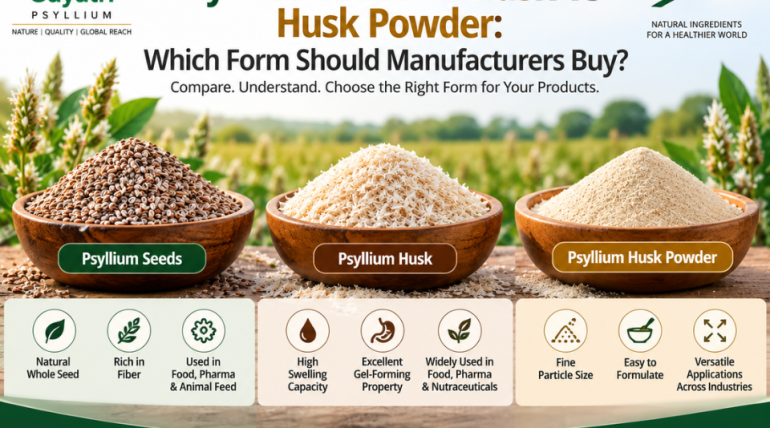
Psyllium Seeds are the whole, cleaned seed of Plantago ovata. They are upstream of husk production and can be a sensible choice for processors that already have the equipment, know-how and quality controls needed to separate or mill the material. Gayatri’s current seed page lists typical physical and chemical parameters including moisture, ash and foreign matter.
Buying seeds gives a processor more control over the downstream conversion step, but it also places more responsibility on the buyer for cleaning, processing yield and final husk or powder consistency.
Psyllium Husk
Psyllium Husk is the seed coat separated during processing. It is a ready ingredient for many fibre and formulation uses where the buyer does not want to run its own husking operation. Gayatri describes husk as the white fibre layer derived from the seed and marketed as a natural dietary-fibre ingredient.
Psyllium Husk Powder
Psyllium Husk Powder is milled husk. It is usually selected when a formulation needs a more uniform particle size, easier integration into a dry blend or controlled powder grade. Gayatri states that its powder range is offered in multiple purity levels and mesh sizes.
Choose by manufacturing objective
Buying for further processing
Choose Psyllium Seeds when your business is set up to process raw seed and you have a genuine operational reason to do so. That may include internal control over husk yield, the need to produce multiple downstream grades or a vertically integrated raw-material process. The trade-off is additional equipment, cleaning, yield loss, QC and handling.
Buying for direct formulation
Choose Psyllium Husk when your application can use the natural husk form without fine milling. This can make sense when particle size does not need to be tightly controlled and the process already handles fibrous material efficiently.
Buying for consumer-ready formats
Choose Psyllium Husk Powder when dispersion, texture, mesh or dosing format makes powder the more convenient commercial input. This is common in dietary-fibre mixes, bakery systems and some nutraceutical formulations. The right mesh still depends on the final product.
A side-by-side comparison
| Form | Best fit | Main specification focus | Trade-off |
|---|---|---|---|
| Psyllium Seeds | Further processing / extraction / husking | Seed identity, cleanliness, moisture, ash, foreign matter, yield expectations | More processing responsibility |
| Psyllium Husk | Direct fibre applications | Purity, swelling, moisture, colour, foreign matter, microbiology | Less control over downstream particle size |
| Psyllium Husk Powder | Formulation and dry blends | Purity, mesh, swelling, moisture, microbiology, packaging | Particle size can influence texture and hydration |
Product choice by industry
Food and bakery
Food manufacturers typically care about reproducible handling, ingredient declaration, taste and texture, and the specific functional behavior needed in the recipe. For gluten-free bakery, powder may offer convenient dispersion, while coarser husk may fit a different process. Bench testing should determine the final choice.
Nutraceutical and supplements
Nutraceutical brands often prefer a ready-to-formulate husk or powder because the raw material arrives closer to the final dosage-form requirement. Specification, microbiology, contaminants, packaging and destination-market compliance become central procurement questions.
Pharmaceutical applications
Pharmaceutical manufacturing demands the clearest link between the raw material specification and the finished formulation. A buyer should define the applicable monograph or internal specification, testing method, particle-size requirement and documentation before approving the supplier.
Animal and industrial applications
For animal-feed and industrial use, a buyer may prefer a lower-cost or application-specific grade rather than premium food-grade material. The correct choice depends on what the material is supposed to do: supply fibre, improve binding, interact with water or serve another technical role. Psyllium Kha-Kha Powder may be relevant in some industrial pathways, but it is a separate material and should not be confused with food-grade husk or powder.
Buy direct from a manufacturer or through a trader?
When direct sourcing is valuable
Direct sourcing can be valuable when you need custom specifications, repeat volumes, private-label packaging, traceability or technical discussions. Gayatri says it operates an ultra-modern processing plant with installed capacity for psyllium husk processing and also describes in-house testing and export experience. Those capabilities can be relevant for buyers who want a repeatable supply relationship.
What to validate either way
- Who actually manufactures the material?
- Can the supplier provide a current lot COA?
- Can the approved specification be repeated on future lots?
- What is the actual MOQ and lead time?
- What packing and storage conditions are supported?
- Can the supplier supply the exact form, mesh and purity required?
- Which export documents are available for the destination market?
Practical decision tree
- Need raw material for your own psyllium processing? → Start with Psyllium Seeds.
- Need natural husk for direct fibre use? → Evaluate Psyllium Husk.
- Need controlled particle size for formulation? → Evaluate Psyllium Husk Powder.
- Need a technical or industrial by-product for binding / soil / feed applications? → Evaluate Industrial Grade Psyllium Kha-Kha Powder separately.
- Need a consumer-ready retail product rather than an ingredient? → Consider finished Psyllium products such as EAGLE Sat-Isabgol, subject to your distribution model and target market.
Conclusion
Psyllium Seeds, Psyllium Husk and Psyllium Husk Powder are not interchangeable buying labels. Each form represents a different point in the processing chain and creates a different balance of convenience, control and cost. The right choice is the one that fits your manufacturing objective and can be specified consistently.
For buyers comparing a Psyllium Seeds Manufacturer India, Psyllium Seeds Exporters, Psyllium Husk Manufacturers In India or Psyllium Products Manufacturers In India, begin with the production step you need the material to perform. Then build the RFQ around that requirement rather than around a generic “best psyllium” request.
Talk to Gayatri Psyllium Industries about your grade, mesh, purity, packaging and export requirement. Request product details, a specification sheet or a quotation at gayatripsyllium.com.
Frequently Asked Questions (FAQs)
What is the difference between Psyllium Seeds and Psyllium Husk?
The husk is the fibre-rich seed coat separated from the whole seed. Seeds are the upstream raw material; husk is the separated fraction used in many finished psyllium products.
Which is better: Psyllium Husk or Psyllium Husk Powder?
Neither is universally better. Powder is usually chosen when particle size and dispersion matter; whole husk can be appropriate when a coarser fibrous form is preferred.
Should manufacturers buy seeds and process them themselves?
Only when the business has the equipment, quality system, labour, yield economics and downstream need to justify the extra step. Otherwise, ready husk or powder can reduce operational complexity.
Why does mesh matter in Psyllium Husk Powder?
Mesh affects particle size, dispersion, texture and process behavior. Two powders with similar purity can still perform differently if their particle-size distributions differ.
How can I find Psyllium Seeds Suppliers India?
Start with manufacturers or exporters who can provide a clear product specification, sample, COA, packaging details, origin information and a repeat-supply plan. Compare suppliers using the same specification.