Industrial Grade Psyllium Kha-Kha Powder: Applications, Buying Guide & Supplier Checklist
Psyllium Kha-Kha Powder is an unusual product in the ingredient market because its value begins with the processing of psyllium rather than with the consumer-facing husk itself. Gayatri describes Kha-Kha as the material that remains after processors separate Psyllium Husk from Psyllium Seeds. The company positions Kha-Kha for industrial uses such as landscaping, soil erosion control, animal feed, and pathway surfacing.
For buyers, the opportunity is straightforward: when an application needs a cost-conscious, fibre-containing or binding raw material, an industrial psyllium by-product may be more appropriate than paying for a higher-grade food or nutraceutical ingredient. The critical point is to define the application first and the material second.
What is Psyllium Kha-Kha Powder?
Where it comes from in psyllium processing
During the mechanical separation of Psyllium Seeds into usable husk, not every fraction becomes finished husk. The remaining material is commonly sold as Psyllium Kha-Kha Powder, Psyllium Industrial Dust or an industrial by-product. The exact composition can vary by processing system and grade, so buyers should use the supplier’s current specification rather than assume all Kha-Kha is identical.
Why it is sold as an industrial material
Industrial Kha-Kha is attractive where the buyer values binding, water interaction, fibre content or economical bulk supply more than the tighter purity and appearance standards of food or pharmaceutical husk. It can serve as a practical raw material for feed, landscaping, and soil-related applications, provided manufacturers validate the grade for the intended use.
Key industrial applications
Animal feed and feed manufacturing
Some feed systems use psyllium-based by-products because their fibre content, water interaction, and binding properties can support formulated feeds. Current supplier guidance indicates applications across cattle, poultry, and compound feed channels. However, feed formulators and buyers should establish the correct grade, inclusion rate, and regulatory status according to destination-market requirements.
Landscaping, erosion control and soil stabilization
Gayatri lists landscaping and soil-erosion prevention as key uses for its Kha-Kha product. The product’s binding and water-retention characteristics can make psyllium-derived materials useful in soil-management systems where the objective is to reduce loose surface material and improve cohesion. Performance should be validated for the local soil, climate and application method.
Pathways and surfacing applications
Gayatri also identifies pathways, courts, car parks, cycle paths, schoolyards and garden surfacing as application areas. Treat these as application examples rather than universal performance claims: a buyer should test the blend, substrate and environmental conditions before commercial use.
Other binding and moisture-retention uses
Industry sources also describe potential uses in agriculture, composting, brick manufacturing and other industrial processes. Because these applications can involve different safety and performance requirements, each project should begin with an application-specific specification and trial.
Industrial grade vs. food-grade psyllium
The most important purchasing distinction is that industrial Kha-Kha is not a drop-in substitute for food-grade Psyllium Husk Powder. A food or nutraceutical product normally needs a different quality profile, documentation set and regulatory pathway. Using an industrial by-product in a human-consumption application simply because it is cheaper is poor procurement practice unless the material has been specifically validated and approved for that category.
The same principle works in reverse: buying premium food-grade psyllium for a soil-binding or industrial application may create unnecessary cost without adding useful performance.
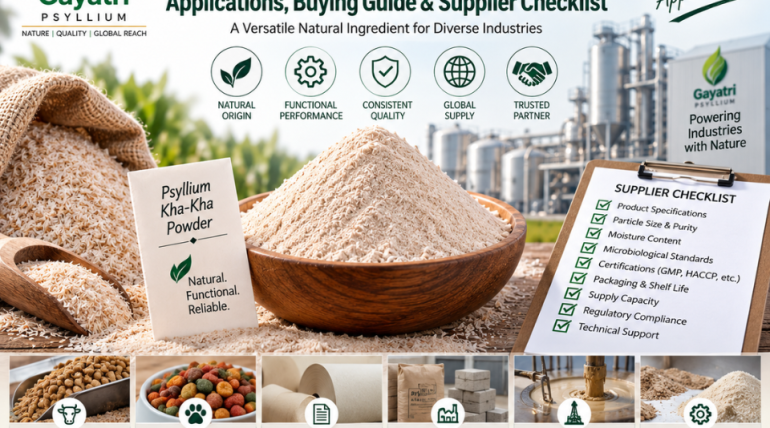
Buyer’s specification checklist
Purity or product definition
Define exactly what the supplier means by Kha-Kha and how the grade is measured. Avoid using “purity” as a vague marketing term.
Moisture, particle size and foreign matter
Moisture affects handling and storage. Particle size affects mixing and application. Foreign-matter limits should reflect the end use. Agree on all three before ordering.
Bulk density and handling
If the powder is being dosed into feed or industrial mixes, bulk density and flow can affect equipment calibration and batching. Ask for practical handling data or test the sample on the real feeder or mixer.
Packaging and storage
Industrial buyers still need protection from moisture and contamination. Specify bag size, liner, palletization and storage conditions. Gayatri’s broader psyllium MSDS recommends cool, dry and closed storage with protection from humidity, rodents and insects.
COA and repeatability
Request a lot-specific COA where applicable and define the key parameters for release. Repeat orders should be tied to the same specification and approval process.
How to source from an Indian manufacturer
RFQ example
A practical RFQ can say: “Industrial Grade Psyllium Kha-Kha Powder for [animal feed / soil stabilization / landscaping / industrial use].
Required particle size:
- Moisture maximum:
- Foreign matter maximum:
- Bulk density target:
- Packing: – kg bags.
- Annual volume: – MT.
- Destination:
Please quote with current specification, COA format, MOQ, lead time and shipment terms.”
Sample and commercial-lot approval
Do not approve an industrial material from a catalogue description alone. Test the sample in the actual formulation or application. For feed, evaluate mixing and pelleting behavior; for soil or landscaping, evaluate wetting, binding and field handling; for industrial mixes, test batch consistency and equipment behavior. Once the sample works, lock the specification before issuing the commercial PO.
Practical example: a feed manufacturer
A compound-feed producer is trying to lower the cost of a fibre and binder component. It requests two Kha-Kha samples from different suppliers, tests both at the same inclusion level, records moisture, mixing behavior, pellet quality and storage stability, then compares total cost per finished tonne. The cheaper material only wins if it performs consistently. This is the difference between buying a commodity and sourcing a usable raw material.
Conclusion
Industrial Grade Psyllium Kha-Kha Powder can create value when the buyer is solving the right problem: fibre, binding, moisture interaction, economical bulk supply or soil-related performance. The best supplier relationship starts with a clear end use and ends with a measurable grade that can be repeated shipment after shipment.
For buyers looking for Psyllium Kha-Kha Powder Suppliers India, Psyllium Kha-Kha Powder Exporters or a Psyllium Kha-Kha Powder Manufacturer India, a sample-plus-specification approach is the safest route to a scalable purchase.
Talk to Gayatri Psyllium Industries about your grade, mesh, purity, packaging and export requirement. Request product details, a specification sheet or a quotation at gayatripsyllium.com.
Frequently Asked Questions (FAQs)
What is Psyllium Kha-Kha Powder?
It is the extraneous material or by-product produced during processing of psyllium seeds into psyllium husk. Suppliers may describe it as industrial dust or industrial-grade Kha-Kha.
Is Psyllium Kha-Kha Powder suitable for human consumption?
Do not assume so. Industrial Kha-Kha should be treated according to its actual specification and regulatory status. Human food and nutraceutical applications need the appropriate food-grade material and documentation.
Which industries buy Kha-Kha in bulk?
Current supplier listings include animal feed, agriculture, landscaping, soil-related uses and other industrial applications. The exact fit depends on the specification and local requirements.
What should I ask a Psyllium Kha-Kha Powder Manufacturer India?
Ask for product definition, specification, particle size, moisture, foreign matter, packaging, COA or test format, MOQ, lead time, sample availability and the ability to maintain the same grade on repeat orders.
Can Kha-Kha be used for soil stabilization?
It is marketed for soil stabilization, erosion control and landscaping applications, including by Gayatri. Actual performance should be validated with your soil, application method and local environmental conditions.