The Growing Demand for Psyllium Products
From Farm to Global Wellness | A Natural Solution for a Healthier Tomorrow
From a traditional fibre to a global functional ingredient
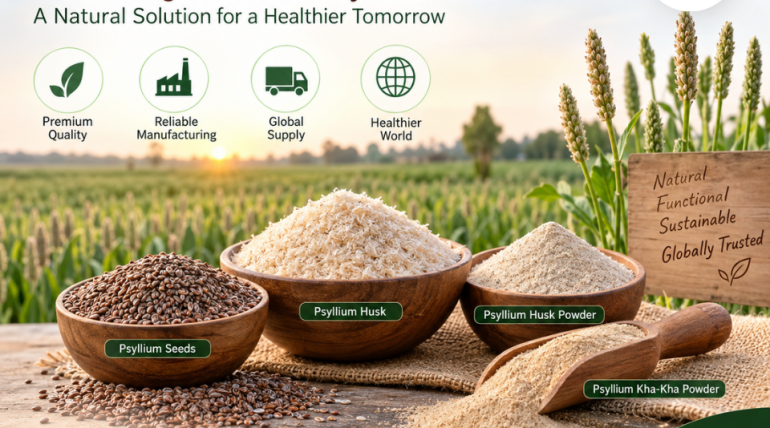
Psyllium has moved well beyond its traditional image as a household fibre supplement. Today, food manufacturers, nutraceutical brands, pharmaceutical companies, and ingredient distributors evaluate the ingredient as a functional plant-based material with multiple uses. Psyllium husk offers valuable fibre content, water-binding behaviour, and viscosity-building properties, while psyllium seeds remain an important raw material for processors. Psyllium husk powder gives formulators a more finely processed format for applications that require controlled dispersion, texture or handling.
Recent scientific reviews describe psyllium as both a nutraceutical and a functional food ingredient, with research covering food applications, physicochemical functionality and new ways to expand its use. That broader application base explains why demand no longer depends on a single product category.
Why is demand for psyllium products growing?
Consumer needs and manufacturer needs together explain the demand for psyllium. Buyers are looking for ingredients that can support fibre-forward products, clean-label positioning and technical performance at the same time.
1. Consumers are seeking more convenient sources of dietary fibre
Fibre has become a practical product-development theme across everyday foods, supplements and wellness products. Psyllium provides a concentrated source of fibre that manufacturers can add to powders, blends, bakery products, and other formulations. For brands, that creates opportunities to build products around fibre without relying on highly complex ingredient systems.
2. Gluten-free and plant-based formulation continues to need functional ingredients
Gluten-free products can be technically challenging because gluten contributes structure and water management in conventional dough systems. Research reviews identify psyllium among plant-derived hydrocolloid or fibre options that can improve water-holding, dough behaviour and texture when used correctly. This makes psyllium especially relevant to gluten-free bakery development, where ingredient functionality matters as much as the nutrition story.
3. Food formulators are looking beyond simple nutrition claims
Psyllium is attractive because it can play a technical role as well as a nutritional role. Its high water uptake, viscosity and gel-forming characteristics can influence texture, moisture management and product structure. That creates a stronger reason for industrial buyers to evaluate psyllium on specification, not simply on price.
4. Global sourcing is becoming more specification-driven
International buyers increasingly need consistency across batches, documentation and predictable supply. For an ingredient such as psyllium, factors such as purity, microbiological control, mesh size, moisture, swelling behaviour, packaging and traceability can directly affect manufacturing performance. This shifts the conversation from ‘Which supplier is cheapest?’ to ‘Which supplier can reliably meet the product specification?’
Why India is important in the global psyllium supply chain
India has a long-established psyllium processing ecosystem, particularly in Gujarat and surrounding growing regions. APEDA’s export classification lists Psyllium Seed (Isobgul) and Psyllium Husk (Isobgul Husk) as distinct agricultural product categories, reflecting the established trade in these products. Gujarat’s Unjha region is also widely recognised as a major market and processing hub for psyllium.
For global buyers, the advantage of sourcing from an established Indian psyllium supplier is not simply origin. The real advantage is access to an ecosystem that combines agricultural sourcing, processing, cleaning, pulverising, testing, packaging and export logistics. Gayatri Psyllium Industries states that it has operated since 2009, is based in Unjha, Gujarat, exports psyllium products to more than 35 countries, and operates a 50,000 sq. ft. manufacturing facility with optical sorting, pulverising, sterilisation and in-house testing capabilities.
Psyllium : one plant, several commercial formats
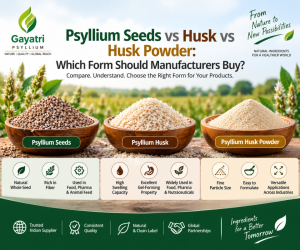
The term “psyllium products” covers more than one specification. Choosing the correct format is essential because processing level and particle size can influence application performance.
| Product format | What buyers should consider |
|---|---|
| Psyllium Seeds | The whole seed is the starting raw material for commercial processing. Buyers may source seeds for further processing, extraction or specific feed and formulation applications. |
| Psyllium Husk | The husk is the fibre-rich outer coating separated from the seed. It is commonly used where a higher-fibre, visible husk format is preferred. |
| Psyllium Husk Powder | Husk processed into a finer powder. Mesh size and handling properties matter because different applications require different dispersion and texture characteristics. |
| Organic Psyllium Husk / Powder | Certified organic formats for buyers whose finished products and supply chains require organic inputs and supporting documentation. |
| Psyllium Kha-Kha Powder | A secondary material generated during psyllium processing. Industrial buyers may evaluate it for application-specific uses, making specification and suitability particularly important. |
| Eagle Sat-Isabgol | Gayatri also markets psyllium husk under its consumer brand Eagle Sat-Isabgol, extending its product portfolio beyond bulk ingredient supply. |
Where is psyllium being used?
| Sector | Typical buyer interest |
|---|---|
| Food & beverage | Fibre-enriched foods, bakery mixes, gluten-free formulations, nutrition powders and texture-focused formulations. |
| Nutraceuticals | Fibre supplements, sachets, capsules and powder blends where ingredient identity and specification control are important. |
| Pharmaceuticals | Psyllium is used in fibre-based products and bulk-forming formulations. Regulatory and pharmacopoeial requirements vary by market, so buyers should confirm the target standard before contracting. |
| Animal nutrition | Selected psyllium materials can be evaluated for animal-nutrition formulations, subject to species, formulation and regulatory requirements. |
| Personal care and other functional applications | Psyllium’s water interaction and film/gel behaviour have encouraged research into broader non-food applications, although commercial suitability should always be validated product by product. |
What global buyers should check before buying psyllium
A reliable psyllium purchasing decision starts with a clear specification sheet. Two products can both be labelled “psyllium husk powder” yet behave differently in a manufacturing process.
- Identity and origin: Confirm botanical identity, product format and country of origin.
- Purity and foreign matter: Define acceptable limits and the supplier’s cleaning and sorting controls.
- Mesh size / particle distribution: Match the powder specification to the intended formulation and processing equipment.
- Microbiological parameters: Confirm the required microbial limits and testing method for the destination market.
- Moisture and storage stability: Moisture can affect handling and shelf stability; agree on a practical specification and packaging format.
- Swelling / viscosity behaviour: For functional applications, performance may matter more than a generic product name. Ask for the relevant test data where applicable.
- Residue and contaminant controls: For food and nutraceutical supply, discuss pesticide residues, heavy metals and other applicable contaminants according to destination-market requirements.
- Documentation: A commercial shipment may require COA, specification sheet, allergen information, declarations, certifications and traceability records.
- Packaging and logistics: Agree on pack size, palletisation, labelling, container loading and storage conditions before the first bulk shipment.
A practical example: how a bakery buyer should source psyllium
Imagine a gluten-free bakery developing a high-fibre bread. The buyer should not start by asking only for the lowest price per kilogram. The better process is to define the flour system, target fibre level, desired dough behaviour, mixing equipment and finished texture. The supplier can then recommend a suitable husk or powder specification and provide a sample for pilot trials.
The bakery should compare sample performance using the same recipe and process conditions. Key observations may include water demand, dough handling, loaf volume, crumb texture, appearance and consistency across repeated trials. Once the procurement team fixes the specification, it can compare suppliers based on landed cost, documentation, quality consistency, and delivery reliability not price alone.
How the psyllium market is changing for suppliers
For suppliers, the opportunity is not simply to sell more tonnes. Buyers increasingly value application knowledge, specification flexibility and dependable export execution. A supplier that can discuss mesh options, testing, documentation, organic requirements, packaging, and pilot samples has a stronger position as a long-term ingredient partner.
Trade-tracking data also shows that international psyllium commerce remains active. Volza reported 2,218 Indian export shipments of psyllium husk/psyllium powder under HSN 1211 involving 457 overseas buyers in its August 2026 dataset. Such commercial datasets are not the same as official national statistics, but they illustrate the breadth of buyer-supplier activity in the category.
Sustainability and the next phase of psyllium sourcing
The next phase of growth is likely to put more attention on the full supply chain: responsible agricultural sourcing, traceability, processing efficiency, waste utilisation and documentation. This is especially relevant as brands communicate clean-label and natural-ingredient stories to consumers while procurement teams simultaneously tighten supplier qualification.
Psyllium’s processing chain also creates opportunities for better resource utilisation. The commercial challenge is to match each output with an appropriate, safe and compliant application rather than treating every fraction as a commodity with the same value.
Why specification-led partnerships matter
A strong relationship with a psyllium supplier depends on consistent quality and reliable performance. A food or nutraceutical manufacturer needs the same expected behaviour batch after batch. That requires more than a product catalogue. It requires controlled processing, testing, documentation, responsive communication and a clear understanding of the buyer’s application.
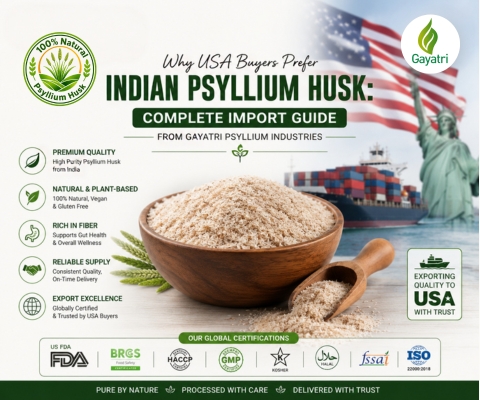
Gayatri Psyllium Industries positions itself as a manufacturer and exporter of Psyllium Seeds, Psyllium Husk, Psyllium Husk Powder and related products. Its published capabilities include a high-tech processing plant, in-house testing, sterilisation and optical sorting, along with certifications and registrations for international trade. Buyers should still evaluate the exact product specification and destination-market requirements for each project before purchase.
Conclusion: from Indian farms to global product innovation
The psyllium industry is evolving because the ingredient now sits at the intersection of fibre-focused nutrition, functional food formulation, gluten-free product development and global ingredient sourcing. The most valuable opportunities are not created by demand alone; they come from matching the right psyllium format and specification to the buyer’s application.
For manufacturers, distributors and brands, the practical lesson is simple: define your specification, test the ingredient in your own process and choose a supplier that can support quality, documentation and supply continuity. For Indian suppliers, the next stage of growth will depend on consistent processing, application support, transparent quality systems and strong international service.
Ready to source Psyllium from India?
Contact Gayatri Psyllium Industries for Psyllium Seeds, Psyllium Husk, Psyllium Husk Powder and related psyllium products. Share your application, specification, quantity and destination market for a focused quotation and product discussion.
Email: export@gayatripsyllium.com
Frequently Asked Questions (FAQs)
Why is psyllium demand growing globally?
Demand is expanding because psyllium can serve both nutritional and technical roles. It is used in fibre-focused products, gluten-free formulations, nutraceuticals and other functional applications, creating demand across multiple industries.
Why do manufacturers source psyllium from India?
India has an established cultivation, processing and export ecosystem for isabgol. Gujarat is a major commercial hub, and Indian suppliers can offer integrated sourcing, processing and export services.
What is the difference between psyllium husk and psyllium husk powder?
Psyllium husk is the separated outer coating of the seed. Psyllium husk powder is a more finely processed form. The preferred format depends on the formulation and the required handling or dispersion characteristics.
What should I ask a psyllium supplier before placing a bulk order?
Ask for product specifications, mesh size, COA, microbiological limits, contaminant controls, certifications, packaging details, sample availability, lead time, minimum order quantity and export documentation relevant to your destination.
Is organic psyllium available from India?
Yes. Organic psyllium is commercially supplied from India, but buyers should verify the exact certification, scope, chain of custody and destination-market requirements for each shipment.
Can psyllium be used in gluten-free products?
Yes. Research supports its potential functional role in gluten-free bakery systems, particularly for water management and texture. Formulations still require controlled trials because psyllium absorbs substantial water and can change dough rheology.
What is Psyllium Kha-Kha Powder?
It is a material generated during psyllium seed processing. Its suitability depends on the intended industrial application and the buyer’s specification, so it should be evaluated as a distinct product rather than assumed to be interchangeable with food-grade husk powder.
How can I source psyllium products from Gayatri?
Buyers can contact Gayatri Psyllium Industries with the required product, application, specification, quantity, packaging and destination country. The company provides an inquiry route and lists export contact details on its website.